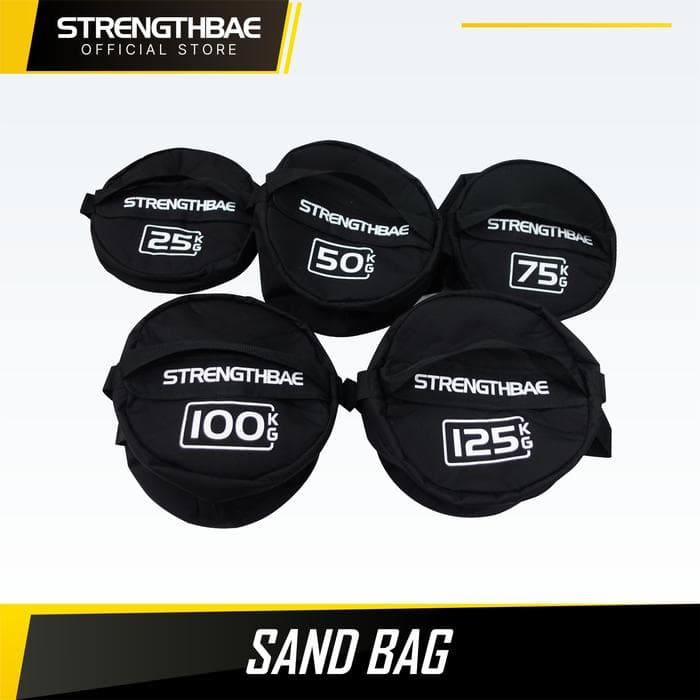
Sandbag: Specifications & Best Training Guide
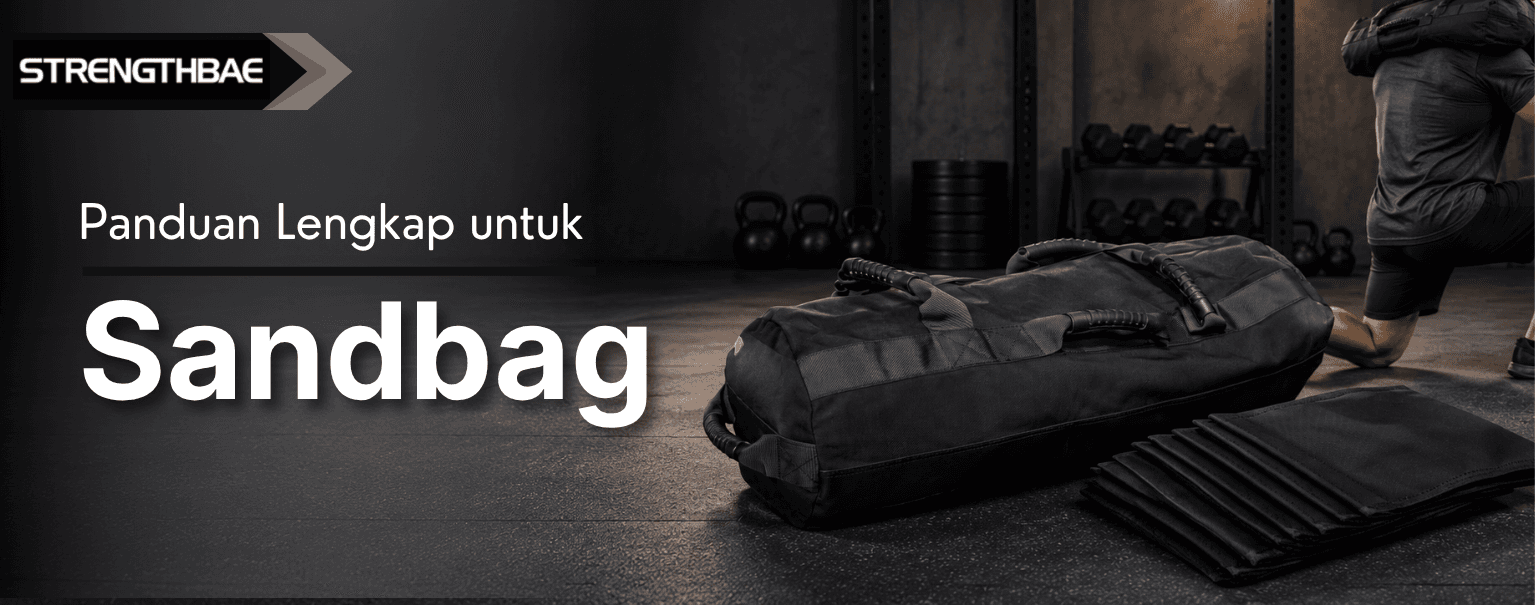
A sandbag is a strength training tool in the form of a durable bag filled with weighted material, usually sand or a filler bag, so the load does not always remain fixed and stable like a dumbbell or barbell.
Lifting a sandbag can feel much heavier than lifting a dumbbell or barbell of the same weight because the load continuously shifts dynamically, creating a shifting mass without a fixed center of gravity. This instability develops real-world strength by forcing your core, stabilizer muscles, and grip to work harder throughout every part of the movement.
This equipment is highly popular for both general fitness training at home and functional endurance sports such as hybrid races like HYROX.
What Is a Sandbag?
A sandbag contains weighted sand that can shift as it is lifted, carried, or moved. Your body has to work harder to maintain balance and positioning.
This is actually one of its main advantages because a sandbag creates a more unpredictable training experience compared with conventional weights. Its shape is not rigid, the grip position can change, and its position often requires your body to continuously adjust throughout the movement.
Because of this, sandbags are commonly used to develop strength that transfers well to real-life movements such as carrying, hugging, lifting, or moving heavy objects.
Why Does a Sandbag Feel Heavier Than a Barbell?
Have you ever tried lifting a 20 kg sandbag and felt as if you were carrying a 30 kg barbell or more?
This physical phenomenon is real and is not simply your imagination. The main reason lies in the biomechanics of static versus dynamic loads.
A dumbbell or barbell has a rigid and stable center of gravity located around the center of the implement. When you perform a press or squat, the load travels through a relatively linear, stable, and predictable path that your nervous system can anticipate.
A sandbag, on the other hand, is filled with loose grains of sand that behave almost like a thick fluid inside the filler bag. This characteristic is known as shifting mass.
Whenever you move, even slightly, the sand flows toward the lowest point due to gravity.
This constant instability triggers asymmetrical motor responses throughout your muscles. Your body is not only responsible for moving the weight upward but must also make continuous micro-adjustments throughout the movement to stabilize the load and prevent it from shifting out of position.
Read also: Dumbbells vs. Barbells: Which One Do You Need?
Is Sandbag Training Good for Core Strength and Functional Strength?
The term “functional strength” is often treated as a marketing buzzword in the fitness industry. However, sandbag training provides a very clear example of what functional strength actually means.
In real life, whether you are carrying a child, moving heavy boxes, or participating in combat sports, objects rarely have comfortable ergonomic handles and perfectly stable centers of gravity like conventional gym equipment.
Sandbags train your body to lift “odd objects” that better simulate real-world physical situations.
Sandbag training can also place significant demands on the core compared with traditional weight training.
When you hold a sandbag in a bear hug position or carry it asymmetrically on one shoulder, the deep abdominal muscles must work continuously through isometric contractions to prevent your body from bending forward or leaning sideways.
This creates a highly three-dimensional form of core training.
Read more: StrengthBae Competition Sandbag
Can a Sandbag Replace a Barbell?
The answer is no.
A barbell remains one of the best tools for large-scale progressive overload. For example, you can precisely increase squat loads to hundreds of kilograms over time.
The purpose of a sandbag is not to replace a barbell, but to fill training gaps that a barbell may not address as effectively, such as coordinative muscular endurance, rotational strength, dynamic grip strength, and overall physical resilience.
Differences Between Standard Training Sandbags, Hybrid Race Sandbags, Bulgarian Bags, and Power Bags
Many people assume that all weighted bags serve the same training purpose. In reality, the physical design of each tool determines what movement patterns and biomechanics it is best suited for.
Equipment Type | Physical Shape | Number of Handles | Weight System | Primary Training Focus |
|---|---|---|---|---|
Power Bag | Rigid cylindrical shape with thick foam surrounding the internal weight | 4–6 fixed webbing handles | Fixed load with no shifting mass | Beginner strength training and fitness circuits |
Sandbag | Cylindrical or compact shape with limited internal sand movement | 2–4 standard fabric handles | Fixed / stable, often permanently filled | Standard lunges, light presses, static squats |
Bulgarian Bag | Crescent-shaped design with curved ends | 2 main end handles plus strap grips | Fixed load with dense wool and sand filling | Rotational swings, rotational spins, overhead throws |
Muscle Activation Analysis: Which Muscles Work the Most?
The distribution and density of the filling material also play a major role in determining how difficult a sandbag feels.
If there is a large amount of empty space inside the main sandbag compartment, the sand has more room to move, making the load feel highly unstable and more difficult to control.
However, if the sandbag is filled too tightly or packed very densely, its training characteristics change significantly. The sand can no longer shift freely, causing the bag to behave more like a conventional rigid weight and reducing the instability that makes sandbag training unique.
Sandbag training activates both the posterior chain and the anterior musculature at the same time. Here is a breakdown of several common movements and the dominant muscles involved:
Sandbag Clean (Floor to Shoulder): Forces the glutes, hamstrings, erector spinae, traps, and grip muscles to work explosively together. Without solid coordination, the sandbag will not land safely on your shoulder.
Sandbag Lunge (Walking Lunges): Places significant demand on the quadriceps, glutes, and hamstrings. The uneven load forces the hips and ankles to maintain stability while moving forward.
Different Carry Variations: The way you carry the sandbag can create very different muscular demands.
Shoulder Carry (Asymmetrical Load on One Shoulder): Places the load on one side of the body. This creates a strong anti-lateral flexion challenge. The obliques on the opposite side must contract intensely to keep the spine upright while walking.
Bear Hug Carry (Held Against the Front of the Chest): Creates significant anterior loading. The upper back, traps, rhomboids, and biceps must maintain continuous isometric tension to prevent the upper body from collapsing into thoracic flexion as the load pulls the chest forward.
Sandbag Standards in Hybrid Race Competitions
In popular global hybrid fitness races such as HYROX, the sandbag appears at the seventh workout station in the form of 100-meter Walking Lunges.
Its placement as the seventh station, after several demanding functional challenges, makes it especially difficult. By that point, your legs may already be heavily fatigued.
Carrying a sandbag on your shoulders throughout the distance can further challenge cardiovascular endurance and core stability.
Below is the official weight division commonly used based on gender and competition category:
Competition Division (Hybrid Race) | Official Weight | Competition Requirements & Rules |
|---|---|---|
Women Open / Women Doubles / Women Relay | 10 kg (22 lb) | The sandbag is placed on the shoulders, and the rear knee must touch the floor during every lunge step |
Men Open / Men Doubles / Mixed Doubles / Women Pro | 20 kg (44 lb) | The sandbag must remain carried throughout the full 100-meter walking lunge distance |
Men Pro / Pro Doubles Men | 30 kg (66 lb) | Full hip extension is required at the completion of each step, and excessively shortened steps are not allowed |
Youngstars (Children / Teenagers) | 5 kg to 7.5 kg | Weight is adjusted according to age group under official instructor supervision |
Violations of these movement standards, such as dropping the sandbag or failing to touch the rear knee to the floor, may result in a time penalty or require the athlete to repeat a lunge section from the start of the designated segment.
How to Choose the Best Sandbag for Your Home Gym
For home gym owners, space efficiency and versatility are often the main priorities.
So, is a sandbag more practical than a dumbbell?
In terms of portability and floor safety, a sandbag has several advantages.
Because it is made from softer materials, a sandbag is less likely to damage ceramic tiles if it is accidentally dropped, although protective rubber flooring with a minimum thickness of around 8 mm is still recommended.
When traveling, you can empty the sand from the bag, fold the Cordura bag into your luggage, and refill it with quartz sand once you reach your destination.
However, to ensure long-term durability, you should pay attention to three important physical quality factors:
Durable Outer Material
Look for premium nylon with a minimum density of around 1000D.
The stitching should be reinforced and ideally double-stitched for commercial-grade durability.
This type of material is designed to withstand repeated abrasion, light water exposure, and regular contact with sweat during training.
Handle Quality & Position
A good sandbag can feature multiple external nylon handles with a non-slip texture.
A design with around seven handles gives you more freedom to perform pulling, pressing, rotational, and gripping movements from different angles.
Leak-Resistant Filler Bag System
Make sure the sandbag includes internal filler bags with a secure double-fold Velcro® closure.
This helps prevent sand dust from leaking onto your home gym floor during intense training sessions.
FAQ
What is a reasonable starting sandbag weight for beginners?
We recommend starting with the StrengthBae Sandbag 10 kg for women.
The sandbag can be partially filled, for example with around 5 kg at first, to help you practice proper movement technique.
For men, the StrengthBae Sandbag 20 kg can initially be filled with around 10 kg to begin a functional strength training program with manageable progression.
Can I perform slamming movements with this sandbag?
StrengthBae sandbags are designed for functional endurance training such as carries, cleans, and lunges, as well as controlled drops.
Avoid forcefully slamming the sandbag from overhead onto the floor because sudden internal air pressure can place unnecessary stress on the bag and reduce its durability.
What type of sand is recommended for filling a sandbag?
Quartz sand or clean, dry fine-grain silica sand is highly recommended.
Quartz sand is dry, low in moisture, and less likely to clump, which helps maintain smooth shifting-mass movement during training.
Build Functional Strength with StrengthBae
StrengthBae is committed to providing high-quality training equipment, including sandbags designed to meet the needs of functional fitness and competition-style training in Indonesia.
One of the key advantages of the StrengthBae Sandbag is its versatility. Its design is suitable for hybrid race-style training, while the use of separate inner filler bags allows the load to be adjusted more easily for progressive training at home.
Contact the StrengthBae Product Specialist team via WhatsApp for a consultation.
StrengthBae is a professional gym equipment brand that provides solutions for commercial gyms, personal training facilities, and home gyms. From racks and All-in-One Trainers to functional training accessories such as sandbags, a wide range of gym equipment is available at Strengthbae.
Correct the sandbag comparison table