Difference Between All in One Trainer vs Power Rack
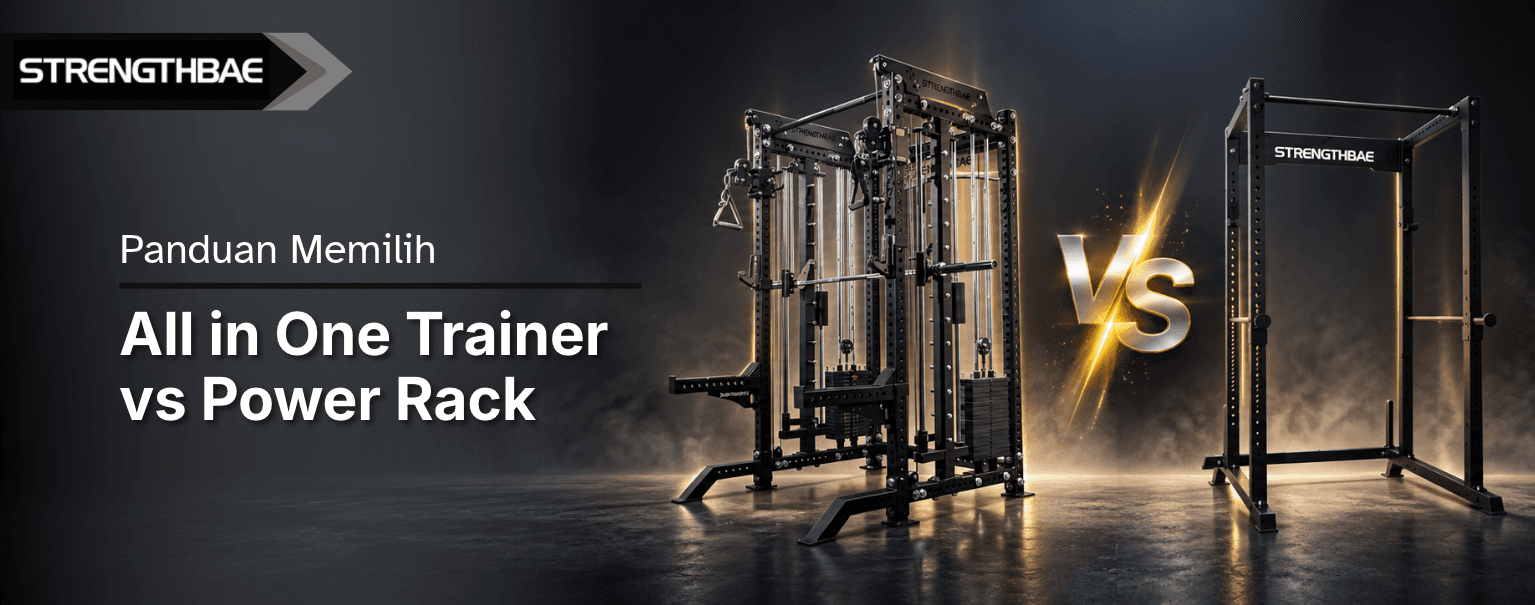
All in One Trainer and Power Rack are two popular options for building a complete home gym or commercial gym.
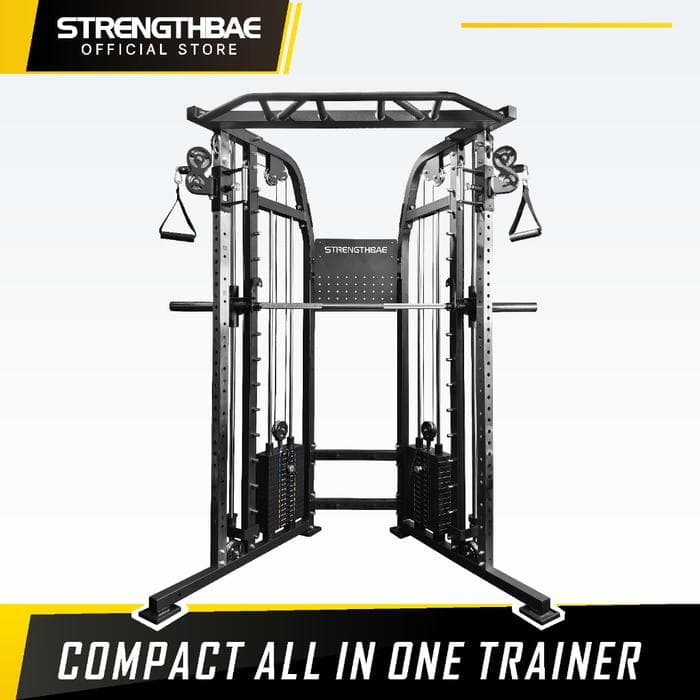
Both can be used for strength training, but they serve different purposes. An All in One Trainer combines multiple pieces of equipment into a single frame, such as a Power Rack, Smith Machine, and cable pulley system.
A Power Rack, on the other hand, focuses on providing a sturdy frame for free-weight barbell exercises such as squats, bench presses, and overhead presses.
The right choice depends on the type of training you want to do, available space, level of convenience, and budget.
What Is an All in One Trainer?
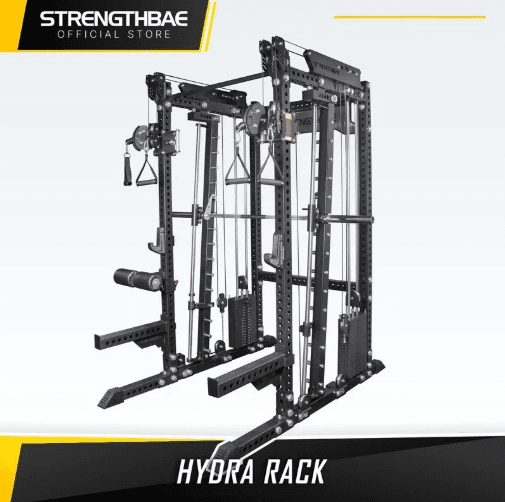
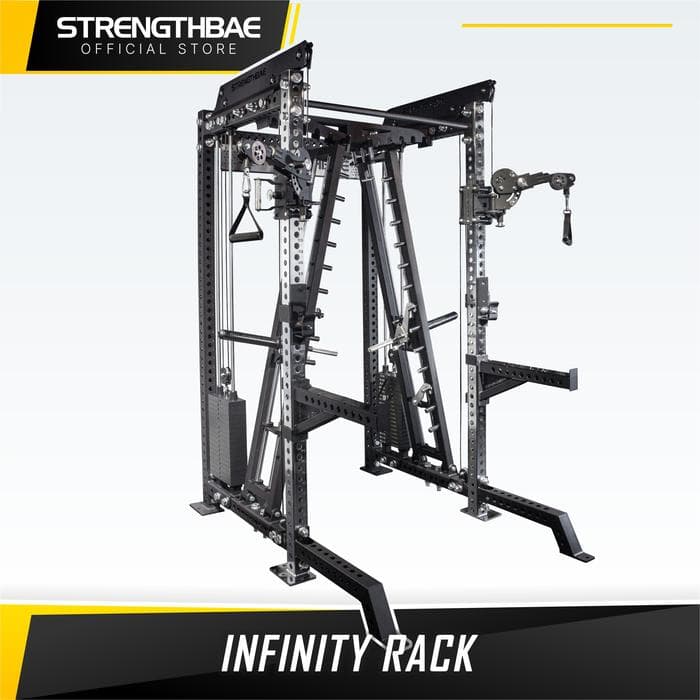
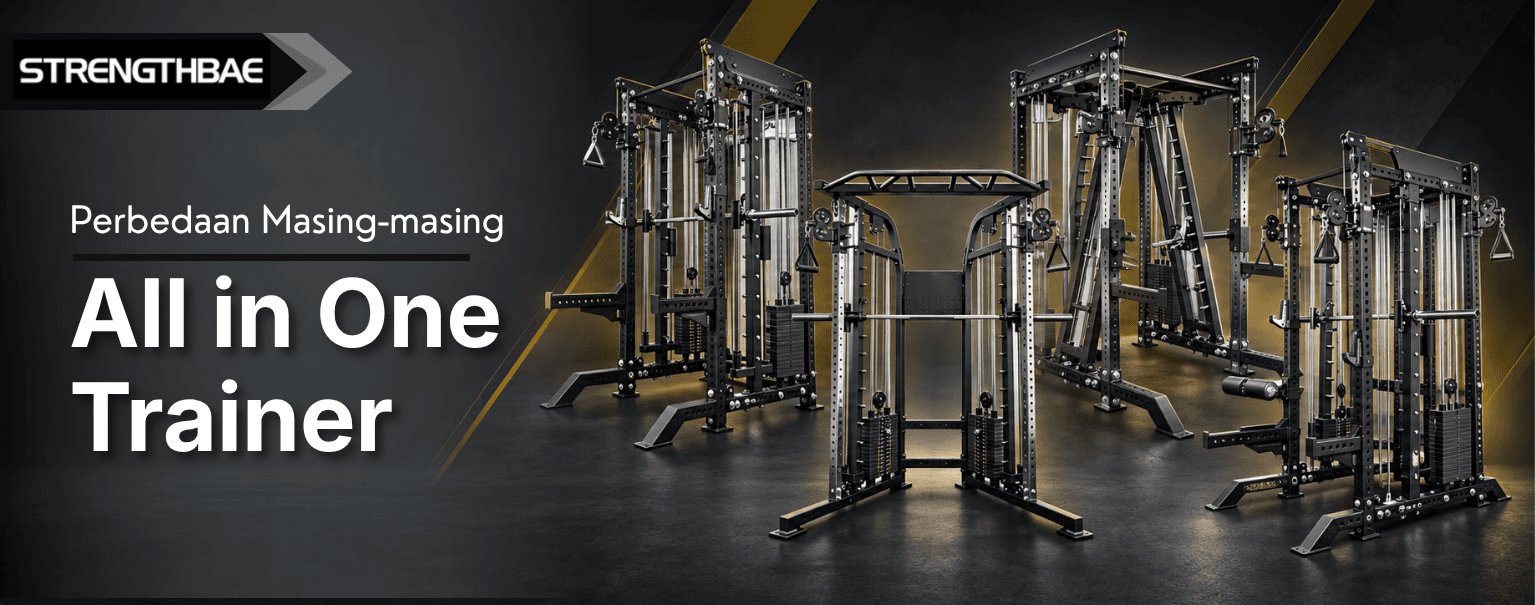
An All in One Trainer is a multifunctional piece of fitness equipment that combines several types of training equipment into a single frame.
Its purpose is to provide a wide range of exercise options without requiring multiple separate machines or a large amount of space.
Common components include:
Power Rack: For barbell exercises such as squats and presses.
Smith Machine: A barbell with a guided movement path for more stable training.
Cable Machine / Functional Trainer: An adjustable cable and pulley system for various movements.
Pull-Up Bar: For bodyweight exercises.
Lat Pulldown & Low Row: For back exercises using both high- and low-pulling movements.
Weight System: Can use weight plates or a weight stack, depending on the model.
Additional Attachments: Such as a dip bar, landmine, leg press, jammer arm, and row footpad.
With an All in One Trainer, users can switch between free-weight exercises, Smith Machine exercises, and cable training within a single area.
However, the features and configurations can vary between models, so it is important to check the specifications before choosing one.
What Is a Power Rack?
A Power Rack is a sturdy steel frame with four or more upright posts designed for barbell and free-weight training.
The rack helps support the barbell while providing safety features for training with heavy loads.
The main components of a Power Rack include:
Upright Post: Vertical posts with holes for adjusting accessory positions.
Crossmember: Connecting bars that keep the frame sturdy and stable.
J-Hook: Supports used to hold the barbell before and after training.
Safety System: Safety features such as safety pins, safety bars, safety arms, or safety straps.
Pull-Up Bar: A bar at the top for pull-up exercises.
Power Racks are primarily used for free-weight exercises such as squats and barbell presses.
The rack can also serve as a base unit that can be equipped with various attachments according to your training needs.
Read More: Power Rack Strengthbae
Summary of Differences Between All in One Trainer vs Power Rack
Criteria | All in One Trainer | Power Rack |
|---|---|---|
Main Function | Combines Rack, Smith Machine, and Cable | Frame for free-weight training |
Movement | Guided movement on Smith & Cable, free movement on Rack | Free movement using a barbell |
Weight System | Weight stack, plate-loaded, and free weight | Barbell and weight plates |
Weight Changes | Quick, especially with a weight stack | Slower because plates must be loaded manually |
Space Requirements | Space-efficient for multiple functions in one machine | Compact, but requires additional space if other equipment is added |
Weight Progression | Depends on the capacity of the weight system used | Highly flexible and can be continuously increased with weight plates |
For Beginners | Easier because of guided movements | Requires proficiency in free-weight technique |
Maintenance | More involved because it includes cables, pulleys, and rails | Simpler, mainly involving frame and bolt inspections |
Initial Investment | Higher because multiple functions are integrated | More affordable and can be expanded gradually |
Structural Differences Between All in One Trainer vs Power Rack
An All in One Trainer has a more complex construction because it combines multiple training systems within a single frame. All features are integrated into one machine, so you do not need to add separate attachments.
It includes a Smith Machine, cable and pulley system, weight stack or loading sleeves, and a rack. Because it has more moving components, it also requires more regular adjustment and maintenance.
A Power Rack, on the other hand, has a simpler construction with a sturdy steel frame. Its primary function is to support the barbell and provide a safety system during free-weight training.
Because it has fewer moving components, a Power Rack tends to be simpler to use and maintain. Additional attachments can be added according to your needs.
Besides expanding its functionality, adding attachments to a Power Rack can also turn it into a self-built All in One Trainer, depending on the range of attachments installed.
Training Differences Between All in One Trainer vs Power Rack
An All in One Trainer offers more exercise variety because it combines multiple training systems in one machine.
You can perform Smith Machine exercises such as squats, incline presses, and hip thrusts; cable exercises such as chest flyes, lateral raises, triceps pushdowns, and biceps curls; as well as lat pulldowns, low rows, pull-ups, dips, barbell exercises, and even leg presses with the appropriate attachment.
A Power Rack, on the other hand, focuses more on free-weight barbell exercises such as back squats, front squats, bench presses, incline presses, overhead presses, deadlifts, rack pulls, and bent-over rows.
A Power Rack can also be used for pull-ups and dips, including with added weight. However, the number of exercise variations still depends on the components and attachments used.
Weight System Differences Between All in One Trainer vs Power Rack
An All in One Trainer can use multiple weight systems in a single machine, including free weights with a barbell and weight plates, plate-loaded systems on the Smith Machine or cable system, and a selectorized weight stack that can be adjusted simply by moving a pin.
A Power Rack, on the other hand, generally uses free weights, with barbells and weight plates loaded manually.
When equipped with a cable attachment, its weight system can be either plate-loaded or weight stack, depending on the type of attachment used.
Therefore, in terms of weight systems, an All in One Trainer is generally more convenient for quick weight changes, while a Power Rack with weight plates provides the flexibility to continuously increase the load as your strength improves.
Size and Space Requirements: All in One Trainer vs Power Rack
An All in One Trainer combines multiple training stations into a single unit, making it more space-efficient.
However, an All in One Trainer still requires sufficient movement space for barbell exercises, cable exercises, an adjustable bench, pull-ups, and overhead presses. For barbell and weight plate use around the machine, a room width of at least 2.4 meters is ideally recommended.
A Power Rack has a simpler construction, but requires around 2.4–2.5 meters of space to comfortably use a 2.2-meter Olympic barbell. Additional space is also needed for a bench, weight plate storage, and pull-up movements.
Therefore, an All in One Trainer can save space because multiple functions are integrated into one machine, while a Power Rack requires additional space if you want to add other machines or training equipment.
Load Capacity and Stability: All in One Trainer vs Power Rack
The load capacity of an All in One Trainer depends on the strength of its frame and each individual system. Check the steel thickness, weld quality, J-Hook and safety bar capacity, Smith Machine rails, and cable load limit.
A Power Rack, on the other hand, focuses more on the strength of its frame, J-Hooks, and safety system when supporting a barbell, including when a heavy load is dropped. Commercial Power Racks with 3×3-inch uprights and 11-gauge steel generally have high load capacities of around 400–500 kg or more.
However, an All in One Trainer is not automatically stronger than a Power Rack, and vice versa. The actual capacity should always be checked against the specifications of each individual product.
Safety Feature Differences Between All in One Trainer vs Power Rack
An All in One Trainer comes with several built-in safety systems, such as J-Hooks and safety arms in the rack area, locking mechanisms and safety stoppers on the Smith Machine, as well as carabiners and cable safety features in the cable system.
A Power Rack uses J-Hooks and a safety system that can include safety pins, safety bars, or safety straps to catch the barbell if a lift fails.
Both can provide a good level of safety during solo training, as long as the safety system is properly positioned before starting the exercise.
Budget Comparison: All in One Trainer vs Power Rack
An All in One Trainer requires a higher initial investment because it combines a rack, Smith Machine, and cable system in a single unit. However, compared with purchasing all three separately, the total investment can be more cost-effective.
A Power Rack has a more affordable starting price for a basic setup. However, the total cost can increase when you add cable attachments, a weight stack, barbell, weight plates, and other accessories.
For a more accurate cost comparison, calculate all required items such as a bench, barbell, weight plates, shipping, and installation to ensure that the configurations being compared are truly equivalent.
Attachment Flexibility and Upgrade Options: All in One Trainer vs Power Rack
All in One Trainer supports various attachments such as Dip Bar, Landmine, Lat Pulldown Seat, Row Footpad, Leg Press, Jammer Arm, and Weight Plate Holder. Some models also feature a modular design, allowing features to be added according to your needs.
Power Rack can also be expanded with various attachments, such as Dip Station, Landmine, Lat Pulldown, Cable Tower, Plate Storage, and Barbell Holder. With a complete cable system, a Power Rack can offer functionality similar to an All in One Trainer.
Before purchasing attachments, make sure the tubing size, hole diameter, and hole spacing are compatible with the rack you are using.
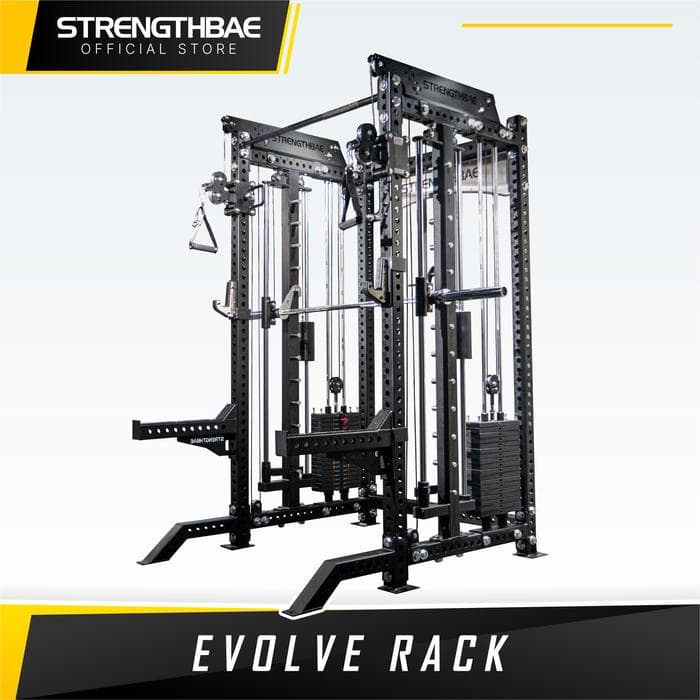
Evolve: An All in One Trainer That Can Be Upgraded
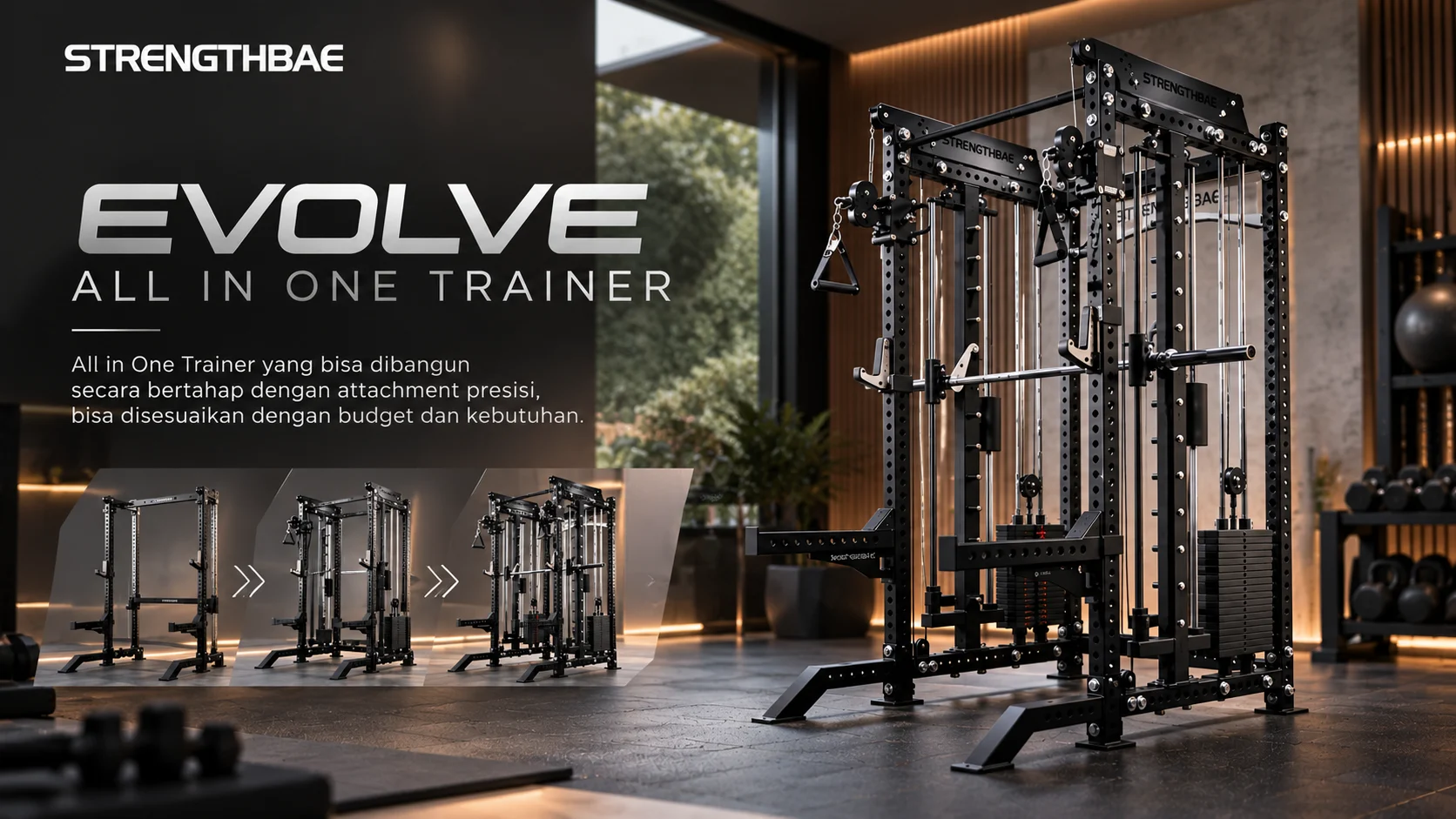
Strengthbae Evolve All in One Trainer offers a different approach from typical All in One Trainers. You do not have to purchase all attachments at once as part of a single installation.
Evolve can be built gradually according to your needs and budget, similar to how you would develop a Power Rack, while each component is designed as part of the same system to ensure better compatibility.
You can start with Rack + 75 kg Stack, then choose a 90 kg or 120 kg capacity based on your training needs. The system can then be expanded with various components such as Storage Peg Board, Weight Plate Holders, Low Row Pedal, Landmine, Jammer Arm, Storage Bar Holder, and Lat Pulldown Seat.
Your training needs can also be customized with the choice of Smith Non Counter Balance or Smith With Counter Balance. This allows you to configure Evolve based on the types of training you want to prioritize without having to purchase all the features from the beginning.
Therefore, Strengthbae Evolve All in One Trainer is suitable for those who want to build a home gym gradually while still having a complete and organized training system. Start with a basic configuration, then expand it according to your training needs until you have a more complete All in One Trainer setup.
Read More: Strengthbae Evolve All in One Trainer
FAQ
Is an All in One Trainer suitable for beginners?
Yes. The Smith Machine and cable system have guided movement paths that are easier to learn, while a Power Rack can be used as beginners progress to free-weight training.
For heavy-weight training, should I choose an All in One Trainer or Power Rack?
For strength training and powerlifting with heavy loads, a Power Rack is more suitable because it uses a free barbell and is not limited by the capacity of a weight stack. An All in One Trainer, meanwhile, offers greater flexibility for strength training, bodybuilding, and various other types of exercise.
How much space is needed to install an All in One Trainer or Power Rack?
It is recommended to provide an area of approximately 2.5 × 3 meters with a minimum ceiling height of 220 cm. This provides enough space for the equipment while allowing room for movement and loading weight plates onto a 220 cm Olympic barbell.
Does an All in One Trainer require more maintenance?
Maintenance is slightly more involved because it includes a Smith Machine, weight stack, cables, and pulleys. These components need to be cleaned, lubricated, and inspected regularly. A Power Rack is simpler and generally only requires routine inspections of the bolts and frame.
Take Your Training to the Next Level with Strengthbae All in One Trainer and Power Rack
Choosing between an All in One Trainer and Power Rack depends on your training goals, available space, and budget. A Power Rack is ideal for free-weight training with a focus on strength, while an All in One Trainer offers more functions in a single machine and greater convenience for various types of training.
Strengthbae offers five All in One Trainer and Power Rack options that can be tailored to the needs of both home gyms and commercial gyms. If you are unsure which option is right for you, consult the Strengthbae team about your available space, training needs, and budget.
Strengthbae ais a professional gym equipment brand providing solutions for commercial gym businesses and home gyms. From racks and All in One Trainers to functional training accessories for HYBRID RACE, everything is available at Strengthbae.