HYROX Station 8: 100-Rep Wall Balls Guide
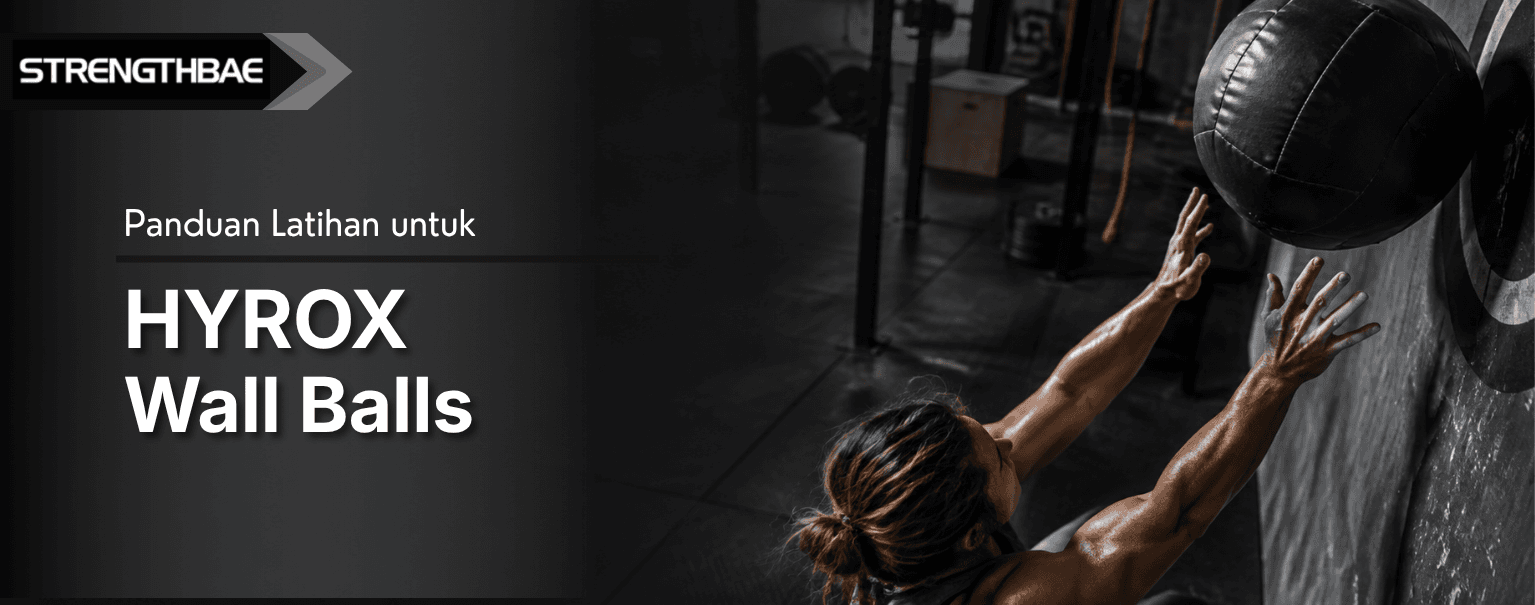
Wall Balls is the eighth and final HYROX station, requiring each participant to complete 100 valid wall ball throws to the designated target height after completing an 8 km run and the previous seven stations.
This movement combines a below-parallel squat with a wall ball throw to the target in a continuous sequence. Mastering the Wall Balls load specifications for each division, the target height rules, and efficient hip drive technique is essential for completing this final HYROX station without receiving time penalties or experiencing extreme fatigue.
HYROX Wall Balls Specifications and Rules
In the official HYROX competition format, all participants across every division are required to complete a total of 100 valid Wall Balls repetitions to finish the race. The ball weight and wall target height are determined by the participant’s division and gender category.
HYROX Category / Division | Wall Ball Weight | Official Target Height | Number of Repetitions |
Women Open / Doubles Women / Relay Women | 4 kg | 2.70 meters (9 ft) | 100 reps |
Women Pro / Men Open / Doubles Men / Mixed | 6 kg | 2.70 m (Women Pro) / 3.00 m (Men) | 100 reps |
Men Pro / Pro Doubles Men | 9 kg | 3.00 meters (10 ft) | 100 reps |
Mixed Relays (According to Gender) | Women: 4 kg | Men: 6 kg | 2.70 m (Women) / 3.00 m (Men) | 100 reps |
In addition to the standard load specifications and target heights, there are official rules that participants must follow to avoid penalties.
Fully Upright Starting Position: Participants must begin the movement from a fully upright standing position with the hips and knees completely extended before performing the first squat.
Squat Depth: On every repetition, the hips must descend below the level of the knees. A squat that is not deep enough will be considered invalid (no-rep).
Ball Must Hit the Target: The center of the ball must clearly make contact with the official target. If the ball misses the target or hits outside the designated area, the movement is considered a no-rep.
No-Rep Penalty: Each no-rep does not count toward the total of 100 valid repetitions, so the participant must repeat the movement, costing additional time and energy.
No Chalk Rule (Chalk Penalty): The use of chalk/magnesium is strictly prohibited at the Wall Balls station and results in a 2-minute time penalty if violated.
Ball Catching System: After the ball hits the target, participants may catch it immediately and absorb the movement into the next squat, or allow the ball to fall to the floor and pick it up again from a fully upright standing position.
How to Perform HYROX Wall Balls
HYROX Wall Balls are performed using the following structured steps to maintain a smooth rhythm and achieve valid squat depth:
Stand facing the wall target while holding the wall ball directly in front of your chest, with your feet shoulder-width apart.
Start from a fully upright standing position with the hips and knees completely extended.
Lower your body into a squat until your hips are below your knees.
Drive through the floor using your legs and hips explosively to return to standing.
Use the force generated by your legs and hips to release the ball toward the official target height.
Catch the ball as it comes down, then use the ball’s downward momentum to transition back into the next squat in a controlled manner.
Repeat this movement cycle consistently until you complete 100 repetitions approved by the judge.
Why Can HYROX Wall Balls Feel So Difficult?
HYROX Wall Balls are often one of the toughest physical and mental challenges because they come at the very end. At this stage, the participant’s body is already experiencing extreme accumulated fatigue. The body is carrying fatigue from the previous HYROX sequence.
The quadriceps and glutes have already been working throughout 7 km of running and the following stations in sequence: SkiErg, Sled Push, Sled Pull, Burpee Broad Jump, Rowing, Farmer’s Carry, and Sandbag Lunges. The shoulders, triceps, and grip have also already been heavily used during Farmer’s Carry and Rowing.
The Wall Balls movement itself combines squats, hip drive, and repeated overhead ball throws with very little natural rest. As fatigue increases, coordination and technique also tend to decline more easily, increasing the risk of no-reps and forcing participants to perform additional repetitions.
Main Muscles Working During HYROX Wall Balls
Wall Balls are a full-body functional movement that activates nearly all major muscle chains:
Quadriceps (Front Thighs)
Control the lowering phase during the squat and act as the main driving force for extending the knees when standing back up.
Glutes
Generate explosive hip drive (hip extension) when pushing the body upward and throwing the ball.
Hamstrings (Back Thighs)
Help stabilize the knee and hip joints throughout the squat and standing phases.
Calves
Help transfer pushing force from the feet to the upper body during the small jump/push.
Core
Stabilizes the torso during the squat, when receiving the descending ball, and when transferring force from the lower body to the upper body.
Shoulders & Triceps (Back of the Arms)
Guide and push the wall ball precisely toward the official target height.
Upper Back
Keeps the torso upright and stabilizes the ball close to the chest.
Efficient HYROX Wall Balls Technique
Apply the following seven technique principles to save energy and maintain your throwing rhythm throughout all 100 repetitions:
Use Your Legs for Power
Avoid turning Wall Balls into a shoulder press. Use your hips and legs as the main source of power, while your arms only guide the ball.
Find the Right Standing Distance from the Target
Do not stand too close because the ball may rebound too vertically. Do not stand too far away either, as the ball will require excessive horizontal force. Find a comfortable distance where the ball can naturally return to your chest.
Use the Ball’s Momentum
As the ball comes back down, catch it in a controlled manner and use its downward momentum to transition directly into the next squat.
Maintain Consistent Squat Depth
Do not shorten your squat depth when you start to feel tired. Make sure the hip crease remains below the knees to prevent a no-rep.
Aim at the Target Consistently
Keep your eyes focused on one target point so the throwing path remains stable and easy to predict.
Break Up the Repetitions Strategically
Do not force yourself to complete all 100 reps at once if you are not yet able to. Use a planned set strategy, for example 10 sets x 10 reps or 5 sets x 20 reps, with short standing rest periods.
Control Your Breathing Regularly
Exhale as you drive upward and throw the ball, then inhale as you catch the ball and perform the squat.
How Beginners Should Train HYROX Wall Balls
For beginners, training should be built gradually to master movement coordination before aiming for a volume of 100 repetitions. Ideally, first learn the two main fundamentals of Wall Balls: squatting to the correct depth and coordinating the transition from the squat into the throw.
Use a lighter wall ball, for example 2–4 kg, so the movement pattern and throwing direction are easier to control. Start with small sets of around 5–10 repetitions, then gradually increase to 15–20 repetitions per set. Total training volume can also be increased little by little, for example from 30, 50, 75, up to 100 repetitions.
In addition to the number of repetitions, focus your training on throwing accuracy, breathing rhythm, and consistent squat depth. Once your technique becomes more stable, add training under fatigued conditions, for example running 400 meters followed by 25 Wall Ball repetitions.
Common Beginner Mistakes When Performing Wall Balls
Avoid the following common beginner mistakes to prevent no-rep penalties and early fatigue.
Squat Not Deep Enough: The hips do not descend below the knees, resulting in a no-rep decision from the judge.
Ball Does Not Hit the Target: The throw is too low or misses the official target area.
Relying Only on the Shoulders and Arms: Not using leg drive causes the shoulder and arm muscles to fatigue quickly.
Throwing the Ball Too High: Wastes energy and makes the ball path more difficult to catch.
Standing Too Close or Too Far Away: Disrupts the catching rhythm and forces the body to make excessive position adjustments.
Sprinting Through the Repetitions at the Start: Forcing a high pace during the first 20 reps can leave you out of breath in the middle of the station.
Waiting Until Failure Before Resting: Waiting until the shoulders or legs completely fail before stopping results in a much longer recovery time.
Not Training According to the Movement Standard: Becoming accustomed to shallow squats during daily training can become a problem during competition.
Gym Exercises That Help with HYROX Wall Balls
To build supporting strength in the thighs and shoulders, as well as cardiovascular endurance, develop your training through the following structured gym exercise variations:
Squat
Squats using a barbell, dumbbells, or Smith machine help build foundational strength in the quadriceps, glutes, and lower body to support the Wall Ball movement.
Goblet Squat
The goblet squat uses a dumbbell or kettlebell held in front of the chest to train squat depth, an upright body position, and movement control.
Thruster
The thruster combines a squat and an upward press in one movement. This exercise helps train the coordination of the legs, hips, shoulders, and arms in a pattern similar to the Wall Ball.
Medicine Ball / Wall Ball Squat Throw
This movement is the most similar to the Wall Ball because it trains the squat, target throw, timing, rhythm, and endurance at the same time.
Front Squat
The front squat helps strengthen the quadriceps and core while training the body to remain upright in the squat position.
Shoulder Press
The shoulder press helps strengthen the shoulders and triceps used when pushing the ball upward.
Box Squat
The box squat helps train consistent squat depth by using a box as a reference for the bottom position.
Treadmill or Air Bike Interval
Interval training helps the body become accustomed to continuing to move at a high heart rate, making it useful for race preparation.
Sandbag Lunges
Sandbag lunges help build leg endurance while also training the body under fatigue before entering the Wall Ball station.
Strengthbae Competition Wall Ball Options
To support functional strength training, conditioning, and HYROX competition simulation preparation in both home gyms and commercial gyms, Strengthbae provides Competition Wall Balls in various weight options: 2 kg, 4 kg, 6 kg, 9 kg, and 12 kg.
The Strengthbae 4 kg Competition Wall Ball matches the official standard weight for the Women Open category. It is ideal for learning technique, building training volume, and women-specific simulation training.
Meanwhile, the Strengthbae 6 kg Competition Wall Ball matches the official standard weight for the Men Open, Women Pro, and several Doubles/Mixed divisions. It is suitable for daily conditioning and squat throw training.
Finally, the Strengthbae 9 kg Competition Wall Ball matches the official standard weight for the Men Pro category. It is highly suitable for professional competition simulation as well as extra-load training (overload training).
There are also 2 kg & 12 kg options. The Strengthbae 2 kg Competition Wall Ball can be used for beginners or technical drills, while the 12 kg version can be used for extra-load strength training.
FAQ
Can beginners use a Competition Wall Ball for daily training at home?
Absolutely. Beginners are advised to start with lighter ball weights (such as 2 kg or 4 kg) to safely master squat depth and throwing coordination in a home gym or commercial gym.
How many times per week should you train Wall Balls?
Wall Balls can be included 1 to 2 times per week in conditioning circuit sessions. Training this movement while physically fatigued after cardio exercise is highly effective for building physical endurance.
Is Wall Ball equipment suitable for home gym and commercial gym facilities?
Absolutely. Wall Balls are space-efficient and highly versatile functional training equipment for home gyms, while also being a popular option in commercial gyms to support functional training classes and preparation for fitness or hybrid events such as HYROX.
Why is squat depth so important when performing Wall Balls?
Squatting below the knees ensures full active engagement of the quadriceps and glutes and is also an official movement standard that must be followed for the repetition to be considered valid by the judge.
Train HYROX Wall Balls with Strengthbae
Completing the 100-repetition Wall Balls station requires a combination of thigh muscular endurance, shoulder strength, movement coordination, and training equipment with precise specifications. For fitness competition preparation or improving everyday physical performance in a home gym or commercial gym, you can contact the Strengthbae team for complete information about gym equipment with an official warranty.
Strengthbae is a professional gym equipment brand that provides solutions for commercial gym businesses and home gyms. From racks and All in One Trainer rainer to functional training accessories such as HYROX-standard Wall Balls, everything is available at Strengthbae.