HYROX Station 7: 100-Meter Sandbag Lunges Guide
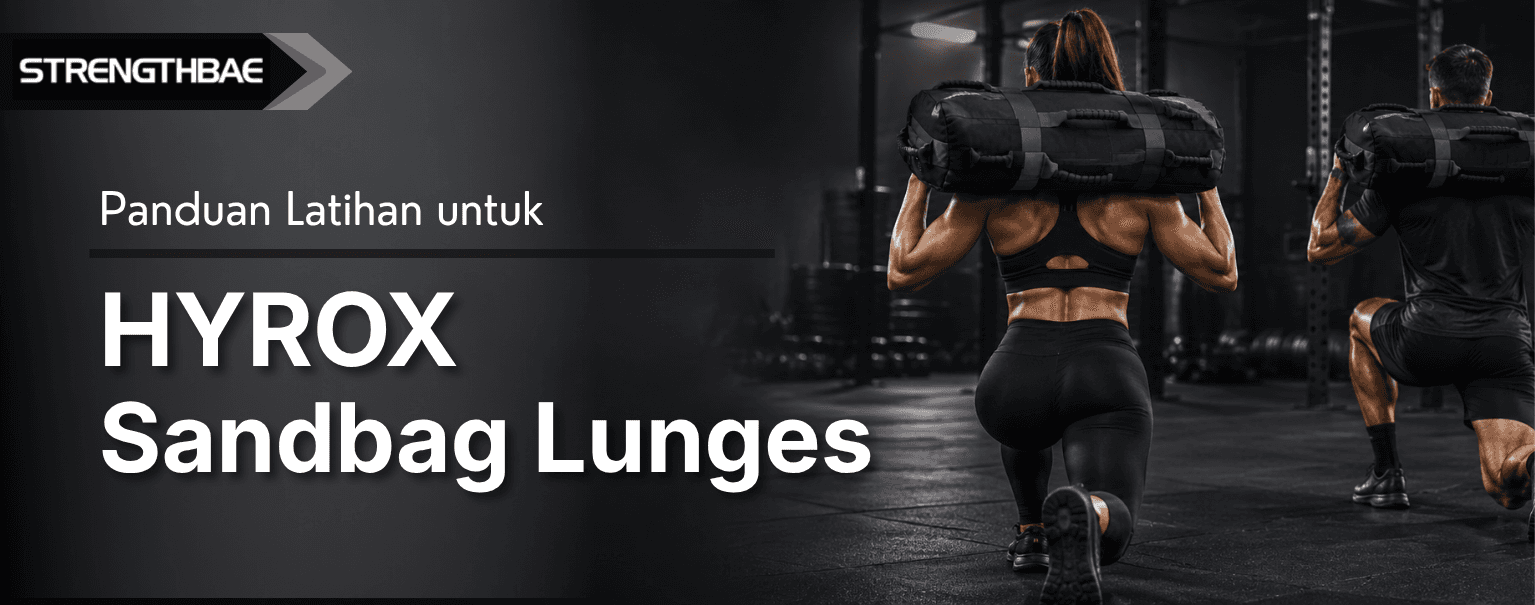
The 100-meter Sandbag Lunges is the seventh HYROX station, where participants are required to perform walking lunges while carrying a sandbag across both shoulders. Positioned right after completing the first six stations and seven kilometers of running, this challenge tests a combination of thigh and glute muscular endurance, core strength, body balance, and movement efficiency when the body is already highly fatigued. This article covers the official load specifications for each division, movement standards and rules, an analysis of the muscles involved, energy-efficient lunge techniques, and supporting exercise variations.
HYROX Sandbag Lunges Specifications and Rules
In HYROX, the Sandbag Lunges station requires each individual participant to complete a total walking lunge distance of 100 meters. For the Doubles category, the 100-meter distance can be divided flexibly between the two team members. The required sandbag weight is determined by the participant's division and gender category.
HYROX Category / Division | Official Sandbag Weight |
Women Open / Women Doubles / Women Relay | 10 kg |
Women Pro | 20 kg |
Men Open / Men Doubles / Mixed Doubles / Men Relay | 20 kg |
Men Pro / Pro Doubles Men | 30 kg |
Mixed Relay | Women: 10 kg | Men: 20 kg |
In addition to the specified load weights, there are standardized movement requirements and official rules that participants must follow to avoid time penalties or disqualification:
Sandbag Position: The sandbag must be carried across both shoulders (back rack position) throughout the full 100-meter distance. The sandbag may not be lowered to the chest, held underneath with the hands, or placed on the floor while moving.
Rear Knee Contact: On every lunge step, the rear knee must clearly touch the floor.
Full Hip & Knee Extension: Each repetition is considered valid once the participant returns to a fully upright position with the hips and knees fully extended.
Alternating Lunge Pattern: The movement must alternate between the left and right leg.
No Extra Steps (No Stutter Steps): Participants are not allowed to take small balancing steps (shuffles/stutter steps) between repetitions.
Course Line: The footprint of the front foot must fully cross or pass the boundary line and turnaround point.
Penalty for Violations & Putting the Load Down: If a participant places the sandbag on the floor while moving, they will receive a 5-meter distance penalty or a 15-second time penalty. Putting the sandbag down for a second time will result in disqualification (DQ) from the race.
How to Perform Sandbag Lunges in HYROX
Efficient Sandbag Lunges begin with the technique used to lift the load and continue with maintaining a consistent stepping rhythm.
Lift the sandbag from the floor to your shoulders using one of three technique options
Stand upright behind the starting line with your core tightly braced and your eyes looking straight ahead.
Take one step forward with a moderate and controlled stride length.
Lower your center of gravity until the rear knee gently touches the floor, while the front knee forms an angle of at least 90 degrees.
Push your body back up using the strength of the quadriceps and glutes of the front leg until the hips and knees are fully extended.
Continue with the next step using the opposite leg, alternating until you complete the 100-meter distance.
You can choose the Touchdown variation (the rear foot briefly stops level with the front foot to maintain balance) or Step-Through (step forward immediately without pausing for greater speed).
Why Can Sandbag Lunges Feel So Difficult?
Sandbag Lunges are often considered one of the most mentally and physically challenging stations in HYROX for several main reasons:
Accumulated Fatigue: The Sandbag Lunges station is placed seventh, after participants have completed 7 km of running as well as the SkiErg, Sled Push, Sled Pull, Burpee Broad Jump, Rowing, and Farmer's Carry stations.
Unilateral Nature of the Movement: Each step is unilateral, meaning one leg must support and drive the body weight plus the sandbag load alternately without assistance from the other leg.
Upper-Body Load: Sandbag Lunges continuously place pressure on the shoulders and upper back muscles, forcing the core and trapezius muscles to work hard to keep the torso stable and prevent it from bending forward.
Repeated Thigh and Glute Work: The quadriceps and glutes undergo eccentric contractions while lowering and concentric contractions while rising repeatedly throughout the 100-meter distance.
High Breathing Demand: Positioning the sandbag on the shoulders and maintaining a continuous stepping rhythm limits expansion of the chest cavity, making breathing feel very difficult with little opportunity to recover.
Main Muscles Working During HYROX Sandbag Lunges
The Sandbag Lunges movement involves the integrated work of various major muscle groups in the lower, middle, and upper body:
Quadriceps (Front Thighs)
Act as the main driving muscles to control the lowering phase during the lunge and generate force to return to a standing position.
Glutes
Play a major role in hip extension, maintaining hip stability, and driving the body upward from the bottom position.
Hamstrings (Back Thighs)
Help maintain knee and hip joint stability and support the upward movement from the lunge position.
Calves
Help stabilize the ankles, control foot contact with the floor, and provide support during each step.
Core (Abdominal & Core Muscles)
Keep the torso upright and stable so the body does not lean, rotate, or bend forward while supporting the sandbag load.
Upper Back and Trapezius
Work isometrically to support and maintain the position of the sandbag across the shoulders throughout the 100-meter course.
Efficient HYROX 100-Meter Sandbag Lunges Technique
To complete the 100-meter Sandbag Lunges safely and efficiently, apply the following six technique principles:
Use a Consistent Stride Length
Avoid taking steps that are too long or too short. Find a stable, moderate stride length that allows the rear knee to touch the floor smoothly without disrupting balance.
Push Through the Front Leg
Focus the pushing force through the front foot, especially the quadriceps and glutes, to return to standing. Avoid relying heavily on body-swing momentum.
Keep the Torso Stable
Try to keep your body upright and stable. Brace your core to prevent the torso from leaning too far forward, which can place extra stress on the lower back.
Stabilize the Sandbag Position
Make sure the sandbag is positioned evenly and comfortably across the shoulders before you start moving. A load that constantly shifts will force the body to make excessive corrections and waste energy.
Use a Sustainable Rhythm
Focus on maintaining a consistent stepping cadence from start to finish. Avoid rushing through the first 20 meters, as this can quickly burn out your thigh muscles.
Control Your Breathing
Avoid holding your breath while stepping. Synchronize a regular breathing pattern with the lunge rhythm, for example inhaling as you lower and exhaling as you push back up.
How Beginners Should Train HYROX Sandbag Lunges
For beginners, Sandbag Lunges training should be done gradually so the body can adapt to the movement and load without compromising technique.
Start with bodyweight walking lunges to train balance, knee control, and body position. Once the movement feels stable, add a light sandbag and begin with short distances, such as 10–20 meters.
Once your technique becomes consistent, gradually increase the distance and load until you approach your training target. Rest periods can also be reduced little by little to improve endurance.
Once your body is more accustomed to the movement, add fatigue-condition simulations by combining running and sandbag lunges, for example running 400 meters, performing 30 meters of sandbag lunges, then running another 400 meters.
Common Beginner Mistakes During Sandbag Lunges
Avoid the following common beginner mistakes to prevent time penalties or early fatigue in the competition arena:
Steps That Are Too Long or Too Short: Steps that are too long make balance more difficult, while steps that are too short create a narrow lunge position and place more pressure on the knees.
Rear Knee Does Not Touch the Floor: This violates the official HYROX movement standard, causing the Sandbag Lunges repetition to be considered invalid.
Not Fully Standing Upright: The hips and knees remain bent when immediately moving into the next step repetition.
Not Alternating Legs: Forgetting to use an alternating stepping pattern.
Torso Leaning Too Far Forward: Allowing the body to bend forward makes sandbag control more difficult and places more stress on the lower back.
Starting Too Fast: Forcing a high pace during the first few meters can cause the quadriceps and glutes to become completely fatigued in the second half.
Never Training While Fatigued: Training only when the body is fresh does not reflect the actual demands of HYROX Sandbag Lunges, which are performed after running and other stations.
Gym Exercises That Help with HYROX Sandbag Lunges
To strengthen the muscles of the thighs, hips, and core stability, develop your physical strength through the following structured gym exercise variations:
Walking Lunge
The most specific exercise using bodyweight, dumbbells, kettlebells, or a sandbag. Walk forward while alternating steps to train unilateral strength, balance, and thigh endurance.
Bulgarian Split Squat
Place one foot on a bench behind you, then perform a single-leg squat movement. This exercise is highly effective for training isolated strength in the quadriceps, glutes, and hip stability.
Squat
Use a barbell, dumbbells, or Smith machine to perform controlled squats and build foundational lower-body strength.
Romanian Deadlift
Use a barbell or dumbbells to train the hip hinge and strengthen the glutes, hamstrings, and posterior chain.
Step-Up
Step up and down onto a plyo box or bench while alternating legs to train single-leg strength, balance, and hip stability.
Reverse Lunge
Perform alternating backward lunges. This exercise helps train control and stability in the lunge pattern before increasing the volume of walking lunges.
Strengthbae Competition Sandbag for HYROX Sandbag Lunges Training
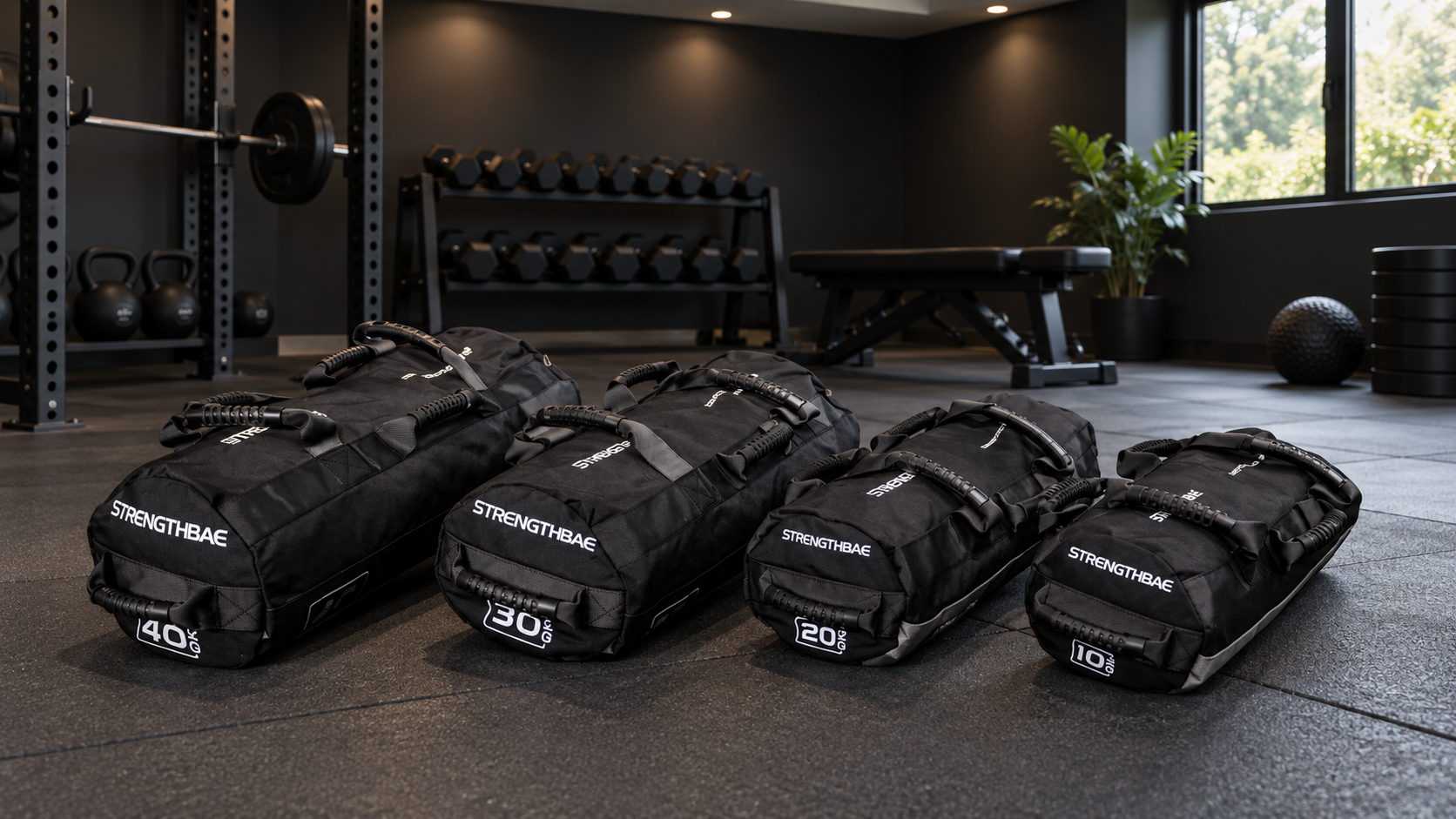
To support functional strength training, conditioning, and preparation for hybrid race competitions at home or in a commercial gym, the Strengthbae Sandbag offers a high-quality training solution. This product is available in weight options that suit competition-standard training, including 10 kg, 20 kg, 30 kg, and 40 kg variants.
The sandbag weight can be adjusted according to your training needs. The 10 kg Competition Sandbag is suitable for lighter training or beginners, while the 20 kg and 30 kg options can be used to match several HYROX competition load standards. For users who want to add more challenge, the 40 kg sandbag can be used for overload training.
The Strengthbae Competition Sandbag is made from heavy-duty synthetic leather, features durable double stitching that resists tearing, and provides stable load distribution. This functional training equipment is highly versatile for Sandbag Lunges, Sandbag Carry, loaded squats, and HYROX training.
FAQ
Can beginners who are trying lunge training for the first time perform 100 m Sandbag Lunges?
Absolutely. Beginners are advised to start with bodyweight walking lunges first to master balance, before gradually adding a light sandbag and progressing toward the 100-meter distance.
What sandbag weight is most suitable for beginners who want to start training at home?
For female beginners, a 10 kg sandbag is ideal as a starting point. Meanwhile, male beginners can start with 10 kg to 20 kg depending on their basic strength level.
Is sandbag equipment suitable for home gym or commercial gym facilities?
Absolutely. A sandbag is a space-efficient and highly versatile piece of functional training equipment for a home gym, while also being a popular training tool in commercial gyms to support functional training classes and preparation for fitness events such as HYROX.
What makes the Strengthbae Competition Sandbag suitable for HYROX training?
The Strengthbae Competition Sandbag is available in 10 kg, 20 kg, 30 kg, and 40 kg options and is equipped with multiple handles, making it suitable for progressive training. This hybrid race sandbag uses four protective layers consisting of an inner bag, zipper, Velcro, and outer bag to help keep the sand securely contained.
The combination of its shape, weight options, and construction makes this sandbag relevant for functional training and preparation for HYROX Sandbag Lunges.
Train HYROX Sandbag Lunges with Strengthbae
Completing the 100-meter Sandbag Lunges station requires a combination of thigh muscular endurance, core strength, body balance, and training equipment with precise specifications.
Whether for fitness competition preparation or improving daily physical performance in a home gym or commercial gym, contact the Strengthbae team for complete information about functional training equipment for various hybrid race competitions such as HYROX.
Strengthbae is a professional gym equipment brand that provides solutions for commercial gym businesses and home gyms. From racks and all-in-one trainers to functional training accessories such as HYROX-standard sandbags, everything is available at Strengthbae.