All Hyrox Workout Stations and Their Benefits
HYROX consists of 8 workout stations, with each station separated by a 1 km run. The event includes a total of 8 km of running and 8 physical challenges performed consecutively without dedicated rest breaks. Each station places different demands on the body, including cardiovascular endurance, upper- and lower-body strength, muscular endurance, explosive power, grip strength, and coordination.
HYROX training should not immediately be performed with the same volume and loads used during competition. Start by learning the basic movements, gradually build your training capacity, and then progress to simulations with durations and loads adjusted to your competition division. Understanding the purpose and benefits of each station can help you create a more effective and safer HYROX training program.
First HYROX Station: SkiErg 1,000 Meters
The first HYROX station is a 1,000-meter SkiErg after the first 1-kilometer run. This movement tests cardiovascular endurance as well as upper-body pulling strength. The HYROX station uses a machine called a SkiErg, which is also commonly referred to as a Ski Trainer.
SkiErg Movement
Start by standing upright while holding the handles overhead. Pull the handles downward forcefully using your shoulders, back, core, and a hip hinge movement. Return the handles upward in a controlled manner before performing the next pull. Maintain a steady rhythm and power output rather than pulling as hard as possible at the beginning and tiring out too quickly.
Benefits of the SkiErg
Improves cardiovascular endurance and aerobic capacity.
Develops upper-body pulling strength and muscular endurance.
Engages the latissimus dorsi, triceps, shoulders, and core.
Improves coordination between the upper body and hip hinge movement.
Helps the body maintain a consistent rhythm and power output over longer durations.
SkiErg Training Progression
Beginner: 4 × 250 meters, 60–90 seconds recovery.
Intermediate: 2–3 × 500 meters, 90–120 seconds recovery.
Advanced: 1 × 1,000 meters at a controlled pace.
HYROX simulation: 1,000 meters nonstop at a pace similar to HYROX.
Second HYROX Station: Sled Push 50 Meters
The 50-meter Sled Push is a pushing exercise that requires lower-body strength and muscular endurance while maintaining core stability. The Sled Push is performed using a wheeled sled, with a designated distance and load placed on top.
Sled Push Movement
Grip the sled handles with your body slightly leaning forward. Push the sled using short, quick, and powerful steps. Keep your core braced so that force from your legs can be transferred efficiently to the sled. Avoid taking overly long steps or pushing too quickly if you are not yet accustomed to heavy loads.
Benefits of the Sled Push
Improves lower-body strength and muscular endurance.
Trains the quadriceps, glutes, hamstrings, and calves.
Develops the ability to generate forward-driving force.
Improves core stability and overall conditioning.
Sled Push Training Progression
Beginner: 4 × 10–15 meters with a light to moderate load.
Intermediate: 4 × 20–25 meters with the load gradually increased.
Advanced: 2 × 25 meters or 4 × 12.5 meters using the target race load.
HYROX simulation: 50 meters nonstop or divided according to your race strategy, using the load appropriate for the Open/Pro division.
Third HYROX Station: Sled Pull 50 Meters
The 50-meter Sled Pull trains the posterior chain and grip endurance. This movement is performed by pulling the sled repeatedly using a rope.
Sled Pull Movement
Connect the power rope to the sled, then stand in a stable position. Pull the rope hand-over-hand, alternating between both hands. Use a combination of your legs, hips, back, and arms to pull the sled rather than relying only on your biceps. Maintain your balance and keep the sled moving steadily.
Benefits of the Sled Pull
Improves full-body pulling strength.
Trains the lats, rhomboids, biceps, forearms, glutes, and hamstrings.
Improves grip and forearm endurance.
Develops core stability and body coordination.
Sled Pull Training Progression
Beginner: 4 × 10 meters with a light load.
Intermediate: 4 × 15–25 meters with the load gradually increased.
Advanced: 2 × 25 meters with a load approaching the target division.
HYROX simulation: 50 meters using the load appropriate for your division and efficient hand-over-hand technique.
Read Also: Third HYROX Station: 50-Meter Sled Pull Guide
Fourth HYROX Station: Burpee Broad Jump 80 Meters
The HYROX Burpee Broad Jump covers a distance of 80 meters and tests cardiovascular endurance and explosive power. This movement uses bodyweight without additional equipment.
Burpee Broad Jump Movement
Start from a standing position, perform a burpee until your chest touches the floor. Push yourself back to a standing position, then immediately jump forward as far as possible using both feet. Land in a stable position and repeat the movement. Keep your jump distance and rhythm consistent to avoid becoming fatigued too quickly.
Benefits of the Burpee Broad Jump
Improves cardiovascular endurance.
Develops explosive power and lower-body and hip strength.
Engages the quadriceps, glutes, hamstrings, chest, shoulders, triceps, and core.
Trains the ability to quickly transition from the floor into a jump.
Burpee Broad Jump Training Progression
Beginner: 4 × 5–10 meters with adequate recovery.
Intermediate: 4 × 15–20 meters with regular intervals.
Advanced: 2–4 × 20–40 meters with shorter recovery periods.
HYROX simulation: 80 meters nonstop while maintaining controlled technique.
Fifth HYROX Station: Rowing 1,000 Meters
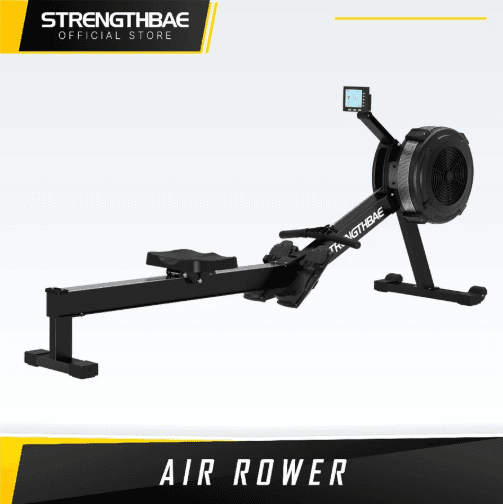
The Rowing station covers 1,000 meters and tests coordination between the leg drive and upper-body pull. This movement is performed on a rowing machine while maintaining a consistent rhythm and pace.
Rowing Movement
Start from the catch position with your knees bent and chest upright. Drive through your legs, then slightly lean your torso backward and pull the handle toward your lower chest. Return the handle forward first, then bend your knees to return to the starting position. Maintain a rhythm of around 24–28 strokes per minute and use a pace that you can sustain until the finish.
Benefits of Rowing
Improves cardiovascular endurance.
Trains muscular endurance throughout almost the entire body.
Engages the quadriceps, glutes, hamstrings, back, and arms.
Develops coordination between the leg drive and upper-body pull.
Rowing Training Progression
Beginner: 4 × 250 meters, 60–90 seconds recovery.
Intermediate: 2 × 500 meters, 90–120 seconds recovery.
Advanced: 1 × 1,000 meters at a steady pace.
HYROX simulation: 1,000 meters nonstop with a split time based on your race target.
Sixth HYROX Station: Farmer's Carry 200 Meters
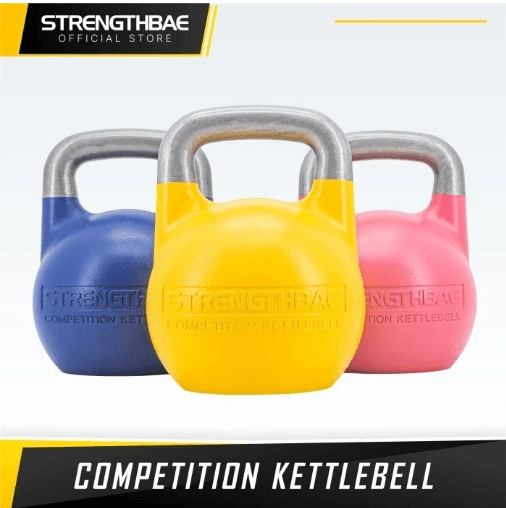
The Farmer's Carry covers 200 meters and tests grip strength, posture, and body stability while carrying a heavy load. The Farmer's Carry uses two kettlebells, one in each hand.
Farmer's Carry Movement
Hold a kettlebell or dumbbell in each hand. Stand upright with your core braced, then walk with controlled steps while keeping your body straight and balanced. Avoid leaning forward or excessively swinging the weights. Once finished, place the weights down safely.
Benefits of the Farmer's Carry
Improves grip strength and forearm endurance.
Trains the trapezius, shoulders, core, hips, and legs.
Improves the ability to carry heavy loads over longer distances.
Helps maintain proper posture and body stability while carrying a load.
Farmer's Carry Training Progression
Beginner: 4 × 25 meters with a light to moderate load.
Intermediate: 4 × 50 meters with the load gradually increased.
Advanced: 2 × 100 meters or several intervals totaling 200 meters.
HYROX simulation: 200 meters total using the load appropriate for your division and dividing the distance according to your race strategy.
Seventh HYROX Station: Sandbag Lunges 100 Meters
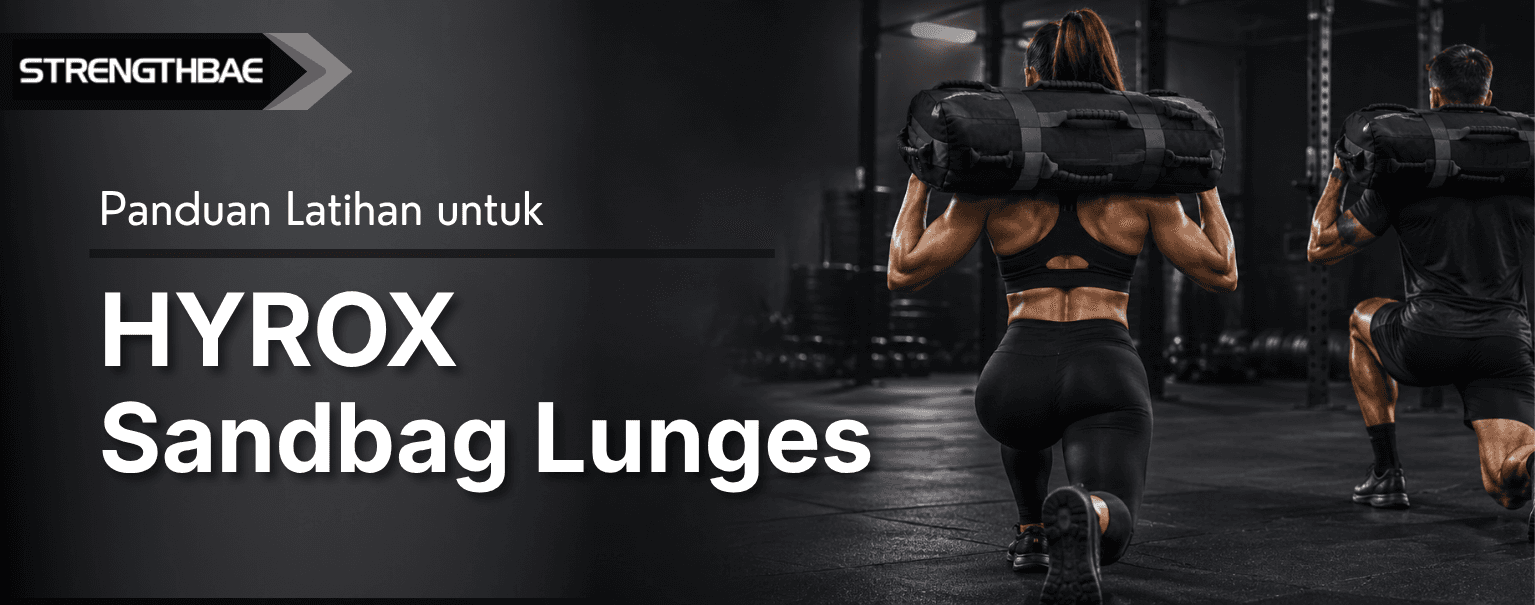
Sandbag Lunges cover a distance of 100 meters and train lower-body strength, balance, and body stability while carrying a sandbag, a layered bag filled with sand as resistance.
Sandbag Lunges Movement
Place the sandbag securely on your shoulders. Step forward with one foot, then lower your body until your back knee is almost touching the floor. Push through your front foot to return to a standing position, then continue with the opposite leg. Keep your chest upright and prevent the sandbag from shifting during the movement.
Benefits of Sandbag Lunges
Improves unilateral lower-body strength and endurance.
Trains the quadriceps, glutes, hamstrings, and calves.
Improves balance and hip stability.
Trains the core to remain stable while carrying a load.
Sandbag Lunges Training Progression
Beginner: 3–4 × 10 meters with a light sandbag.
Intermediate: 4 × 20–25 meters with a gradually increased load.
Advanced: 2 × 50 meters or several intervals totaling 100 meters.
HYROX simulation: 100 meters nonstop using a sandbag appropriate for the competition division.
Eighth HYROX Station: Wall Balls 100 Repetitions
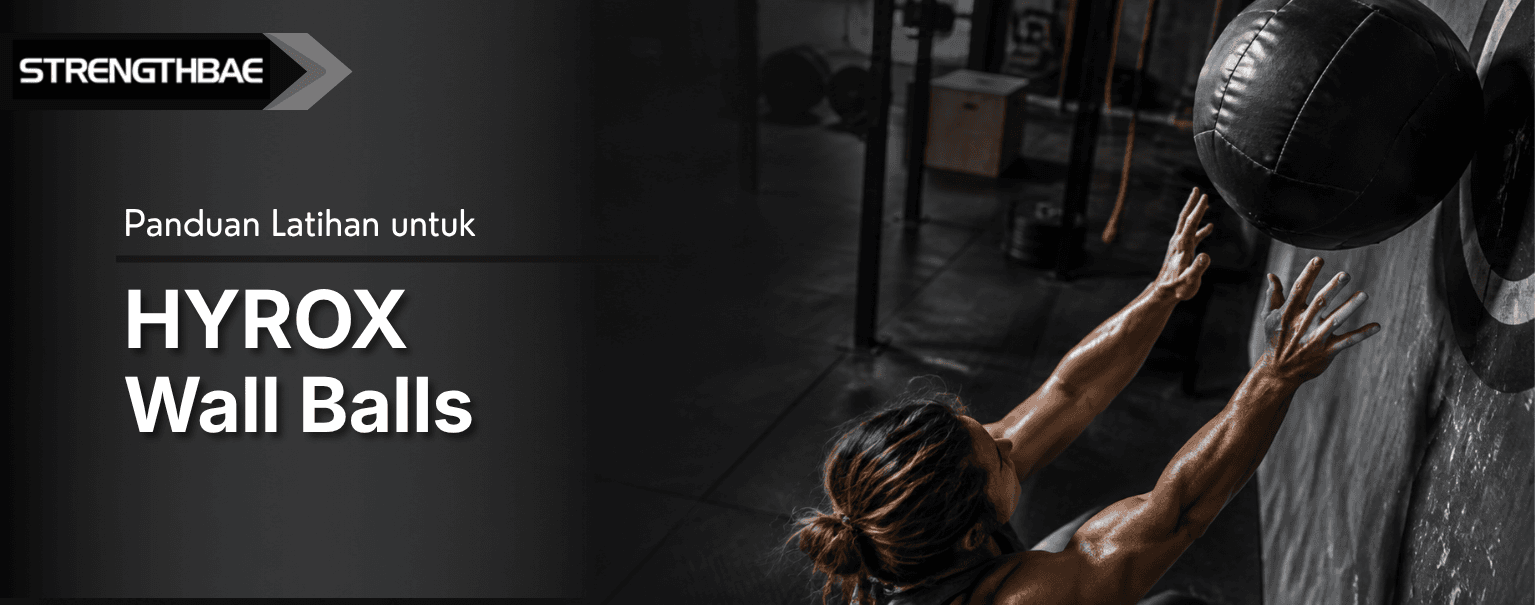
The final station is 100 Wall Ball repetitions, which tests full-body muscular endurance and the ability to maintain performance when the body is already fatigued. The Wall Ball must be thrown to the target to count as a valid repetition.
Wall Ball Movement
Hold the wall ball in front of your chest, then perform a squat to a sufficiently deep position. Stand up by driving through your legs while throwing the ball toward the wall target, which is 3 meters for men and 2.7 meters for women. Catch the ball in a controlled manner and continue into the next squat. Maintain a steady rhythm to avoid becoming fatigued too quickly.
Benefits of Wall Balls
Improves full-body muscular endurance.
Trains the quadriceps, glutes, shoulders, triceps, and core.
Improves cardiovascular endurance.
Develops coordination between the squat and throwing movement.
Wall Ball Training Progression
Beginner: 4 × 10 repetitions, focusing on technique and target accuracy.
Intermediate: 4 × 15–20 repetitions with regular intervals.
Advanced: 2 × 25–30 repetitions with shorter rest periods.
HYROX simulation: 100 repetitions using the ball weight and target height appropriate for your competition division.
Read More: Strengthbae Competition Wall Balls
Comparison of the 8 HYROX Stations
The following table summarizes the distance or repetitions, primary muscle focus, and main equipment used at each HYROX station.
HYROX Station | Distance / Repetitions | Muscle Focus | Equipment |
1. SkiErg | 1,000 meters | Upper body, lats, triceps, core | SkiErg |
2. Sled Push | 50 meters | Quadriceps, glutes, calves, core | Weight sled & turf |
3. Sled Pull | 50 meters | Posterior chain, lats, biceps, grip | Weight sled & power rope |
4. Burpee Broad Jump | 80 meters | Full body, quads, chest | Bodyweight / track |
5. Rowing | 1,000 meters | Full body, legs, lats | Rowing machine |
6. Farmer's Carry | 200 meters | Grip, forearms, traps, core | Kettlebell / dumbbell |
7. Sandbag Lunges | 100 meters | Quads, glutes, core | HYROX sandbag |
8. Wall Balls | 100 repetitions | Full body, quads, shoulders | Medicine ball & target wall |
How to Increase Intensity for Each HYROX Station
Progressive overload in HYROX training should be applied gradually so the body can adapt without excessive fatigue or injury.
Stage 1: Master the Movement
Start with a light load or no additional load. Focus on proper technique, breathing, and range of motion. There is no need to immediately match the competition distance or repetition target.
Stage 2: Increase Volume
Gradually increase the distance, repetitions, or training duration. Rest periods can also be reduced little by little. Continue to maintain proper technique even as fatigue begins to build.
Stage 3: Approach Race Loads
Start using loads that approach the competition standard for your target division, such as Open or Pro. Increase the distance and repetitions while beginning to track pace, split times, and transition times.
Stage 4: Simulate All HYROX Stations
Once you are ready, perform each station at full distance or volume: 1,000 m SkiErg, 50 m Sled Push, 50 m Sled Pull, 80 m Burpee Broad Jump, 1,000 m Row, 200 m Farmer's Carry, 100 m Sandbag Lunges, or 100 Wall Ball repetitions. Focus on maintaining a consistent pace and technique from start to finish rather than simply chasing volume.
FAQ
For HYROX training, which is more important, strength or cardio?
Both are equally important. Cardio is needed to complete the 8 km of running and the ergometer stations, while strength is required for sled pushes, loaded carries, and lunges. Therefore, HYROX training should combine strength and endurance.
How long does it take to improve performance at each station?
Progress can typically begin to become noticeable after 6–12 weeks of consistent training. Consistency, efficient technique, increased training volume, and progressive overload can help improve performance at each station.
Do HYROX station workouts always have to be performed after running?
Not necessarily. When learning technique and building foundational strength, station workouts can be performed while the body is still fresh. As competition approaches, workouts performed after running can be added to help the body adapt to working under fatigue.
How should recovery be managed after HYROX training?
Allow enough recovery time, including 1–2 rest or active recovery days per week. Aim for 7–9 hours of sleep, adequate protein and carbohydrates, and proper hydration to support recovery.
Is HYROX equipment suitable for home gyms and commercial gyms?
Yes. Equipment such as HYROX sandbags, kettlebells, weight sleds, power ropes, and wall balls can be used for functional fitness training in both home gyms and commercial gyms.
Achieve Better HYROX Station Performance with Strengthbae
Each HYROX station requires different physical abilities, so training should not focus only on completing the movements. Start with proper technique and manageable volume, then gradually increase distance, repetitions, load, and training time until you approach race conditions. The goal is to maintain consistent performance from the first station to the last.
Ready to build your HYROX training setup? Contact the Strengthbae team for HYROX equipment consultation, home gym requirements, or commercial gym facility planning.
Strengthbae is a professional gym equipment brand providing solutions for commercial gym businesses and home gyms. From racks and All-in-One Trainers to functional training equipment for HYROX-standard hybrid race training, everything is available at Strengthbae.