HYROX Third Station: 50-Meter Sled Pull Guide
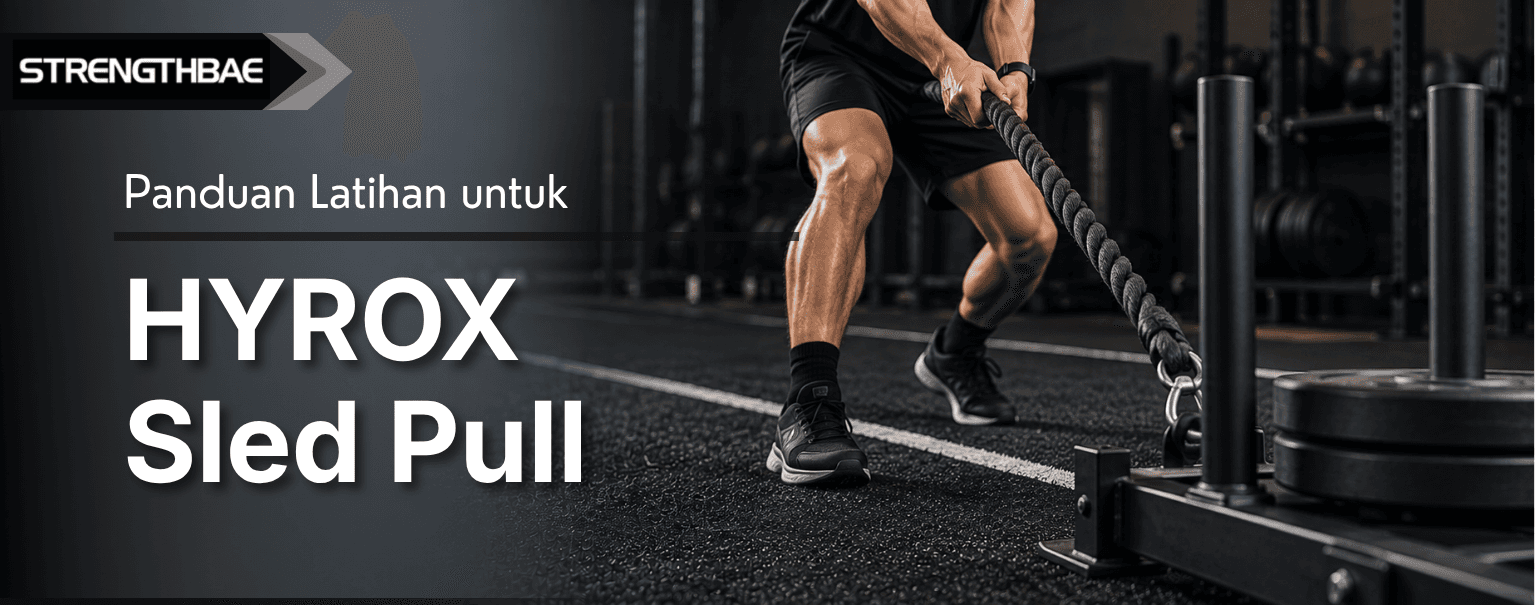
The third HYROX station is the Sled Pull stage, where participants must pull a loaded sled using a rope for a total distance of 50 meters. As the third station in a HYROX competition, the Sled Pull is performed after participants complete the third kilometer of running, the 1,000-meter SkiErg, and the 50-meter Sled Push.
This exercise tests a combination of upper-body pulling strength, back and arm muscular endurance, grip strength endurance, core stability, and efficient leg drive. To make training more effective, practice the technique correctly.
HYROX Sled Pull Specifications and Rules
The Sled Pull is divided into several race divisions. The official distance for the Sled Pull station is 50 meters for all divisions, divided into four 12.5-meter lanes (4 x 12.5 meters). The load being pulled varies depending on the division and gender category of the participant, with the total load including the base weight of the sled plus additional weight plates.
HYROX Division / Category | Total Load (incl. Sled) | Official Lane Format |
|---|---|---|
Women Open / Doubles Women / Relays | 78 kg | 4 x 12.5 meters (Total 50 m) |
Men Open / Doubles Men / Mixed / Pro Women | 103 kg | 4 x 12.5 meters (Total 50 m) |
Pro Men / Pro Doubles Men | 153 kg | 4 x 12.5 meters (Total 50 m) |
Mixed Relays | Women: 78 kg | Men: 103 kg | 4 x 12.5 meters (Total 50 m) |
In addition to the load requirements, there are standard rules that every participant must follow to avoid time penalties:
Participants must remain standing inside the official working area, or Racer's Box, measuring 2 meters at the end of the lane while pulling the rope. Participants are not allowed to pull while sitting or kneeling.
The sled must completely cross the 12.5-meter line before participants are allowed to move to the opposite side and pull again.
The rope must remain within its own lane and must not interfere with or enter another participant's lane.
Participants are not allowed to simply drop the rope outside the Racer's Box or use support outside the boundary line to create additional pulling force.
The station is considered complete after all four lengths are finished and the sled completely crosses the finish line.
How Do You Perform the Sled Pull in HYROX?
The HYROX Sled Pull is performed by standing inside the Racer's Box, gripping the rope firmly, and bracing the core. Participants then pull the rope gradually while using their body weight and pushing backward through the legs, then immediately change position once the sled crosses the 12.5-meter line.
The Sled Pull is not simply about pulling weight with the arms. Efficient pulling force comes from a balance and combination of leg drive, hip extension, upper-back strength, core stability, and grip endurance.
Main Muscles Working During the Sled Pull
The Sled Pull is a full-body resistance exercise that activates several major muscle groups at the same time:
Back Muscles (Latissimus Dorsi, Upper Back, Scapula): Act as the main driving muscles in producing horizontal pulling force from the front toward the abdomen.
Biceps and Forearms: The biceps help bend the elbows when pulling the rope, while the forearms and hand muscles work hard to maintain grip.
Glutes and Hamstrings: Provide driving force when stepping backward and support hip extension and lower-body stability.
Quadriceps: Actively support body weight and push the legs backward to create friction against the sled load.
Core Muscles (Abdominals & Lower Back): Keep the torso stable so it is not pulled forward by the force of the sled.
Shoulder Muscles (Deltoids): Help stabilize the shoulder joints and upper-arm position throughout repeated rope pulls.
Why Does the Sled Pull Feel So Heavy?
There are several factors that make the Sled Pull feel extremely challenging as the third HYROX station.
Floor Friction
The sled is pulled directly across the floor or competition carpet, so the friction is much greater compared with gym machines that move using pulleys.
Inertia When the Sled Stops
Once the sled stops moving, it requires much more energy to get it moving again compared with maintaining existing momentum.
Accumulated Fatigue
The Sled Pull is performed after 3 km of running, the SkiErg, and the Sled Push, so the legs, back, and cardiovascular system are already fatigued.
Grip Endurance Is Drained
Continuously gripping and pulling a thick rope quickly drains finger and forearm strength.
Effect of Floor Surface Type
The type of carpet or synthetic turf used in the arena can increase pushing and pulling resistance even when the actual sled weight remains the same.
Efficient Sled Pull Technique
Use Your Legs, Do Not Pull Only with Your Arms
Use backward steps and hip drive to help generate pulling force. Do not let the biceps and forearms carry the entire load so the arms do not experience local fatigue too quickly.
Maintain a Stable Body Position
Lean the body slightly backward in a half-squat position to use your own body weight as support. Make sure the core remains strongly braced.
Keep the Rope Controlled
Collect the rope neatly beside your body inside the Racer's Box. Avoid letting the rope become tangled around your feet, which can create a tripping risk or interfere with backward steps.
Maintain Momentum
Pull with a consistent and controlled rhythm. Keeping the sled moving continuously is much more energy-efficient than making very aggressive pulls followed by repeated complete stops.
Gym Exercises That Help with the Sled Pull
To build the foundational strength needed for the Sled Pull, you can combine several of the following gym exercises in your workout routine.
Cable Row
Very effective for training the horizontal pulling pattern and strengthening the latissimus dorsi, upper back, and biceps.
Seated Row
Allows you to train back pulling strength from a stable seated position to build strength and muscular endurance in the back.
Lat Pulldown
Strengthens the lats and upper-body pulling chain as a complementary pulling exercise.
Romanian Deadlift
Strengthens the glutes, hamstrings, and posterior chain, which are highly important when stepping backward while resisting load.
Walking Lunge / Reverse Lunge
Trains unilateral strength. The reverse lunge specifically helps improve control during backward stepping.
Farmer Carry
One of the best exercises for training grip strength and core stability while supporting heavy loads.
Cable Resisted Walk
Trains backward or forward walking against cable resistance to simulate the movement pattern of resisting a sled load.
Core Training
Exercises such as the Pallof press, plank, and loaded carry help keep the torso strong against horizontal pulling forces.
How Beginners Should Train the Sled Pull
For beginners, start training with a manageable sled load so you can learn body position, leg use, rope grip, and rope management in a stable way. Begin with a shorter lane before attempting the full 50-meter distance.
Once your movement technique becomes consistent, gradually increase intensity by adding load, extending the distance, or reducing rest time. Specifically for HYROX training, combine the Sled Pull with running. For example, start with a 400-meter run, continue with a 25-meter Sled Pull, then run another 400 meters as an initial training format.
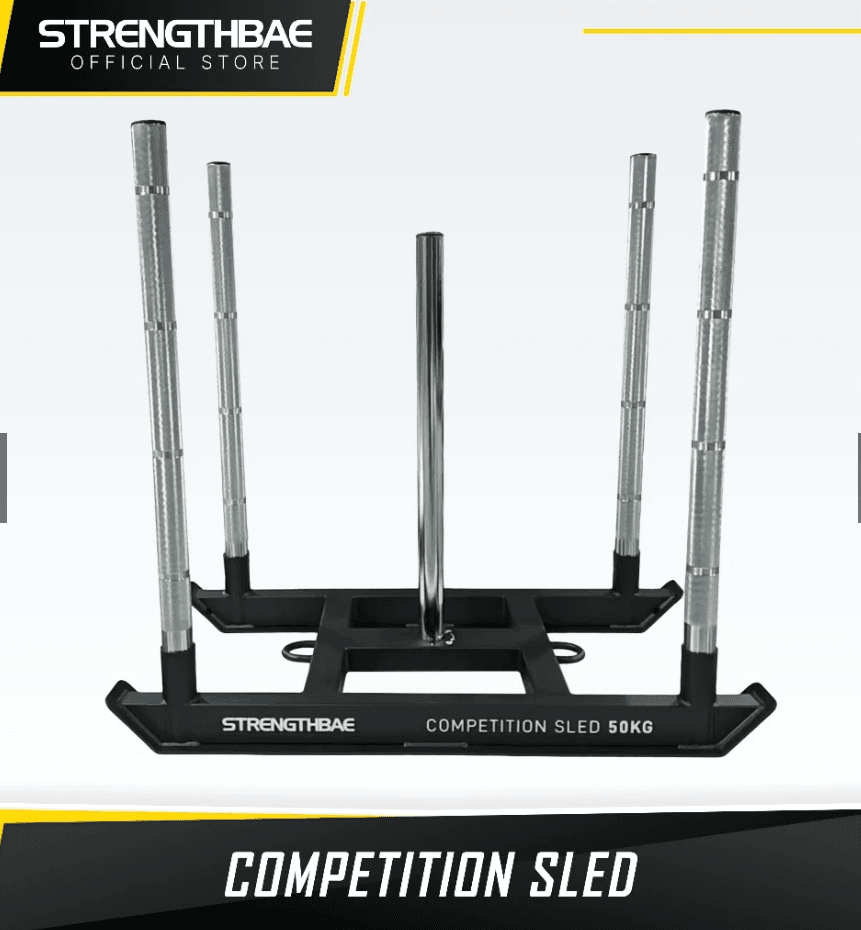
StrengthBae Competition Sled
The StrengthBae Competition Sled is commercial-spec functional training equipment designed specifically for Sled Push, Sled Pull, conditioning training, and preparation for hybrid race competitions such as HYROX.
Built with sturdy heavy-duty steel construction, spacious weight plate loading posts, ergonomic handles, and compatibility with thick ropes, the StrengthBae Competition Sled is ideal for home gyms, personal training studios, and commercial gyms.
What Are the Alternatives If You Do Not Have a Sled?
Although no single gym machine can exactly replicate every characteristic of the Sled Pull, several machines and exercises can be combined to train the main components required, including pulling strength, grip, core stability, and the ability of the legs to generate force while moving backward.
Cable Machine with Rope Attachment
A cable machine with a rope attachment is one of the closest alternatives to the Sled Pull movement pattern, especially when performed using a hand-over-hand motion. This exercise helps train the back, arms, grip, and repeated pulling coordination.
Resisted Backward Walk with Cable
This movement is performed by walking backward while resisting cable tension. Its main focus is training the legs, especially the quadriceps, while helping the body become accustomed to generating force while moving backward as in the Sled Pull.
Seated Row
The seated row helps strengthen the back and arms, which are heavily used when pulling the rope. Although it does not fully replicate the Sled Pull movement, this exercise is useful for building basic pulling strength.
Lat Pulldown
The lat pulldown can also be used to strengthen the back and arm muscles. However, because the pulling direction is from top to bottom, the movement pattern is not as similar to the Sled Pull as a cable rope pull or seated row.
Farmer Carry and Dead Hang
Farmer carries and dead hangs can be added to train grip strength. Grip strength is important because the hands must continuously hold and pull the rope during the Sled Pull.
This combination of exercises can help prepare the physical components required for the Sled Pull. However, if a weighted sled or training sled is available, direct sled training remains the more specific option because the movement pattern and resistance characteristics are closer to the actual conditions.
Common Beginner Mistakes During the Sled Pull
The Sled Pull looks simple because the movement only involves pulling weight toward the body, but poor technique can cause energy to run out quickly and make the movement less efficient. Beginners generally need to pay attention to body position, how they pull the rope, stepping rhythm, and grip use so the movement does not rely only on the arms.
Using Only the Arms
Relying too heavily on the arms causes the biceps and forearms to fatigue very quickly. Use stronger leg drive to avoid this.
Standing Too Upright
A back position that is too upright can reduce the body's support and make it much harder to move a heavy sled.
Pulling Too Fast at the Start
Avoid pulling too quickly at the beginning. It is better to start slowly and steadily so grip strength and breathing do not fail halfway through.
Letting the Sled Stop Too Often
This forces the body to repeatedly use a large amount of extra energy just to overcome stationary inertia.
Uncontrolled Backward Steps
Make sure your backward steps remain stable. Uncontrolled steps can cause the body to lose balance and disrupt the smooth pulling rhythm.
Rope Tangled Around the Feet
A poorly managed rope can interfere with stepping space and may also create a risk of penalties if the rope leaves the lane.
Not Training Under Fatigue
Training only when the body is completely fresh does not reflect the actual demands of a HYROX competition, where the station is performed after running and the two previous stations.
FAQ
What Is the Main Difference Between the Sled Push and Sled Pull?
The Sled Push focuses on pushing the sled forward using lower-body strength. The Sled Pull, meanwhile, requires participants to pull the sled using a rope, placing greater demands on the back, arms, grip strength, and core stability.
Is the StrengthBae Competition Sled Suitable for a Home Gym or Commercial Gym?
Yes. The StrengthBae Competition Sled is designed to be versatile for both home gym and commercial gym use. This StrengthBae sled supports functional strength training, Sled Push, Sled Pull, and cardio conditioning in one unit that already competes with HYROX standards.
How Can I Train for the Sled Pull If I Do Not Have a Sled Yet?
If you do not have a sled yet, you can still train the strength components needed for the Sled Pull separately. Use Cable Rows for pulling strength, Cable Resisted Walks for backward movement against resistance, Reverse Lunges and RDLs for leg strength, and Farmer Carries for grip training.
To complete your HYROX training needs in a home gym or commercial gym, you can find various gym equipment options at StrengthBae.
Is Sled Pull Training Suitable for a Regular Strength Training Program?
Yes. The Sled Pull can be used as an additional exercise to train leg, back, core, and grip strength. It can be performed after the main exercises or as part of conditioning, with the volume adjusted so it does not interfere with recovery.
What Should You Consider When Choosing a Training Area for the Sled Pull?
Choose an area that is long enough, flat, non-slip, and has a surface suitable for sled movement. Also make sure there is enough safe space around the training lane so the pulling movement can be performed without interference from other people or equipment.
Train the Sled Pull with StrengthBae
Conquering the third HYROX station requires a combination of efficient pulling technique, back and leg strength, grip endurance, and precise training equipment. Whether for hybrid race preparation or improving your daily training, you can contact the StrengthBae team for complete information about the latest and most advanced gym equipment.
StrengthBae is a professional gym equipment brand that provides solutions for commercial, personal, and home gym needs. From racks and All-in-One Trainers to functional training accessories such as HYROX-standard sandbags, everything is available at StrengthBae.