Rope Workouts: Battle Rope vs Power Rope
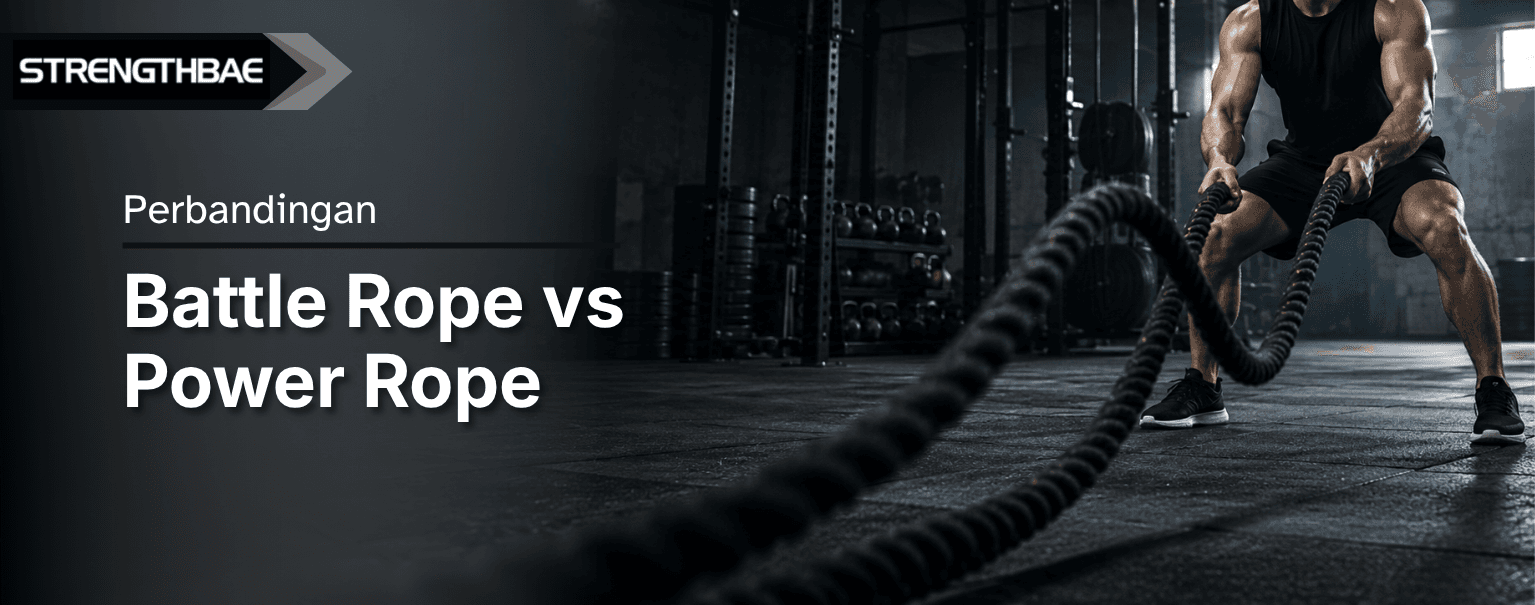
Using ropes for exercise can be part of conditioning, endurance, power, and full-body workouts. Battle rope and power rope are both ropes used for workouts, but their methods of use and training purposes are different. Although in some places the terms battle rope and power rope may refer to the same type of rope, at Strengthbae they are different.
Strengthbae Battle Rope can be attached to an anchor point and moved to create waves, while Strengthbae Power Rope is used with a weight sled to pull the load during functional training and hybrid race workouts. This article discusses the differences between the two, including their design, usage, movement patterns, types of exercises, and which rope is suitable for home gyms and commercial gyms.
What Is a Battle Rope?
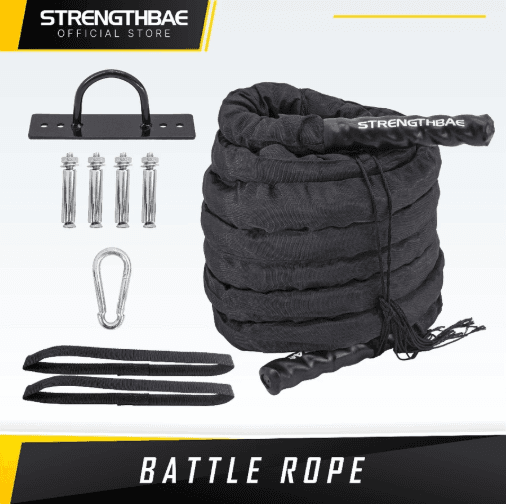
A battle rope is a fitness tool in the form of a thick, long, and heavy rope attached to a fixed point or anchor point, such as a wall, power rack, or dedicated anchor. The user holds both ends of the rope and moves them rapidly to create waves. The level of challenge is influenced by the length, diameter, and weight of the rope, as well as how fast and how far the rope is moved.
Battle rope can be used for various movements such as alternating waves, double waves, rope slams, and rope circles. Because one end of the rope remains attached to an anchor point, the user must continuously generate force to move the rope throughout the exercise.
Strengthbae Battle Rope uses premium Polydacron material that is strong, resistant to fraying, and less likely to leave fibers on the floor. The rope is also equipped with an extra protective sheath and coated handles for a more comfortable grip, especially when used for interval training or HIIT at home or in the gym.
What Is a Power Rope?
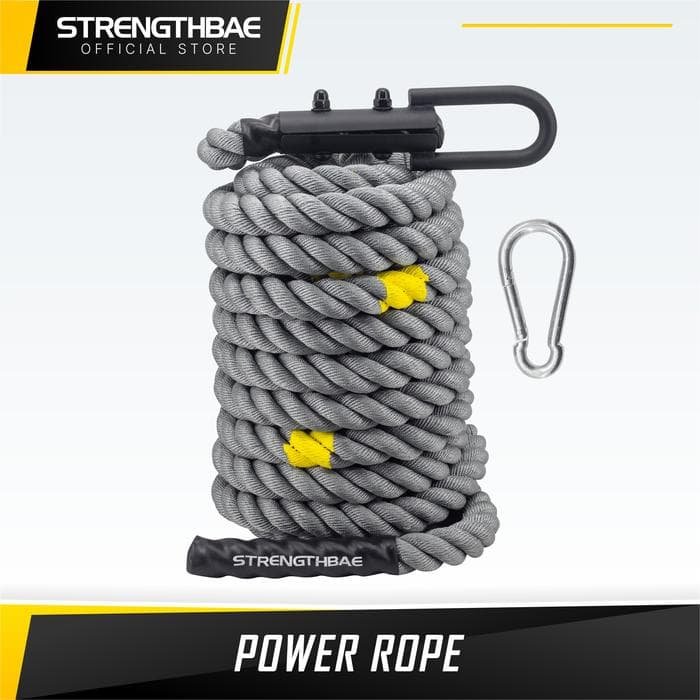
A power rope is a training rope used to pull loads, such as in hand-over-hand sled pulls. Unlike a battle rope, which is attached to an anchor point and moved to create waves, Strengthbae Power Rope is connected to a weight sled or load and then pulled alternately with both hands to move the sled.
Strengthbae Power Rope is made from reinforced Dacron material that is strong and durable for repeated use when pulling heavy loads. With a length of 15 meters and markings every 3 meters, the power rope helps measure distance and manage pacing during training. It is suitable for functional training, strongman, and preparation for hybrid races such as HYROX, particularly for developing pulling strength and grip endurance.
Differences Between Strengthbae Battle Rope and Power Rope
The following comparison table summarizes the technical aspects, movement patterns, and training focus of Strengthbae Battle Rope and Power Rope:
Comparison Aspect | Strengthbae Battle Rope | Strengthbae Power Rope |
Primary Use | Conditioning and HIIT with rope wave movements | Pulling a weight sled or load |
Movement Pattern | Waves, slams, circles, and lateral movements | Pulling, hand-over-hand, and sled drags |
Anchor System | Attached to a wall, rack, or post | Connected directly to a weight sled |
Training Focus | Cardio, muscular endurance, and upper body | Pulling strength, grip endurance, core, and legs |
Space Requirements | Space to move the rope; available in 9 m, 12 m, and 15 m lengths | 15 m track for pulling a sled, ideally with turf |
Typical Exercises | Alternating waves and double slams | Hand-over-hand sled pulls and hybrid race training |
The comparison above shows that both can be used for rope workouts, but they serve different purposes. Battle rope is more suitable for conditioning and wave-based exercises, while power rope is more suitable for pulling loads and developing pulling strength and grip endurance.
Can a Power Rope Be Used as a Battle Rope?
Functionally, a power rope can still be used for some battle rope movements if its size, weight, length, and anchor system are suitable. However, power rope is specifically designed for pulling loads such as sleds, so its characteristics are different from a battle rope designed to generate waves.
Before using a power rope as a battle rope, consider the rope's length, diameter, weight, anchor system, and available training area. For a more comfortable experience and use that matches the equipment's intended purpose, it is recommended to use the type of rope according to its primary design.
Read Also: Third HYROX Station: 50-Meter Sled Pull Guide
Muscles Worked During Rope Workouts
Both types of rope workouts engage multiple muscle groups, but the way they work and the muscles that are most heavily involved are different.
Battle Rope: When moving the rope, the shoulders, arms, upper back, and core work to generate and control the rope's movement. The thighs and glutes also work to keep the body stable throughout the exercise.
Power Rope + Sled: When pulling the sled, the grip and forearms work harder to hold the rope. The back, shoulders, biceps, core, and leg muscles such as the quadriceps and hamstrings also work to generate force and pull the load toward the body.
The muscles involved and the level of resistance can vary depending on the sled weight, movement variation, rope length and weight, pulling speed, and technique used.
Benefits of Rope Workouts
Working with ropes during your workout can provide several fitness benefits, whether for improving physical conditioning or adding variety to your training. Some of the benefits include:
Improves cardiovascular conditioning: High-intensity rope movements can increase heart rate and train cardiovascular endurance. Battle rope is also relatively low-impact because it does not require much jumping or running.
Trains muscular endurance and power: Repeated rope movements require the muscles to work continuously for a certain period. This can help improve muscular endurance and the ability to generate force quickly.
Helps improve grip strength: Holding the rope during training engages the fingers, hands, and forearms. This can help improve grip strength and endurance, which are also useful for exercises such as deadlifts and pull-ups.
Trains body coordination: Rope exercises require coordination between the movements of the hands, core, and legs. This coordination helps the body maintain rhythm and a stable position during training.
Suitable for interval and circuit workouts: Rope exercises can easily be incorporated into HIIT, functional training, or circuit workouts. Users can also adjust work and rest durations according to their fitness level and training goals.
Types of Rope Exercises with Battle Rope
Here are some basic movements that can be performed using Strengthbae Battle Rope:
Alternating Waves
Hold both ends of the rope with your palms facing downward. Stand in an athletic position with your knees slightly bent, then move your right and left hands up and down alternately to create waves traveling toward the anchor point. Maintain a steady rhythm and keep your core engaged throughout the exercise.
Double Waves
Hold both ends of the rope and move both hands up and down simultaneously. This movement requires greater upper-body strength and coordination compared to alternating waves. Keep your body stable and avoid leaning forward while moving the rope.
Rope Slams
Raise both ends of the rope above your head, then slam the rope forcefully and quickly onto the floor. Use a slight movement from the hips to help generate power. Once the rope hits the floor, immediately lift it back up and repeat. This movement is suitable for developing power and conditioning.
Rope Circles
Hold both ends of the rope in front of your body, then move your hands in circular motions either inward or outward. This movement trains shoulder endurance, the upper back, and grip strength.
Read More: Strengthbae Battle Rope
Types of Exercises with Power Rope
Strengthbae Power Rope is best suited for exercises involving pulling loads. Therefore, its variations are not as extensive as battle rope, which can be used for various wave-based movements. Some exercises that can be performed include:
Hand-Over-Hand Sled Pull
Connect the Power Rope to a weight sled, then pull the rope using your right and left hands alternately until the sled moves toward your body. This is the primary use of the power rope and trains pulling strength, grip, arms, back, core, and legs.
Backward Sled Drag
Connect the Power Rope to a weight sled, then walk backward while pulling the sled with the rope. This movement provides a different challenge for the legs, particularly the quadriceps, because the body must continuously move backward while resisting and pulling the load.
Sled Pull Interval
Power Rope can also be used for interval training by combining several rounds of sled pulls with rest periods. For example, pull the sled along the track, rest briefly, then repeat for several rounds. This method can be used to train strength, muscular endurance, and conditioning, with the sled weight and distance adjusted to the user's ability.
Rope Workout Tips for Beginners
For beginners trying rope workouts for the first time, follow these practical guidelines to keep your training safe and effective:
Start with Short Intervals
Start with short exercise durations and sufficient rest periods. For example, perform the movement for 20 seconds, then rest for 30 seconds. As your body becomes accustomed to the exercise, you can gradually increase the workout duration.
Keep Your Core Stable
Engage your abdominal muscles and maintain a stable body position with your knees slightly bent and your chest upright. This position helps maintain balance and reduces unnecessary stress on the back.
Use Your Entire Body
Do not rely only on your arm strength when moving or pulling the rope. Use your legs, hips, and core to help generate force so that your movements are stronger and more controlled.
Make Sure the Anchor Is Secure
Before training, make sure the strap, carabiner, or attachment point on the wall, rack, or sled is securely installed. This is important to prevent the rope from coming loose during use.
Check the Rope Condition
Inspect the rope regularly, especially the sections that frequently come into contact with the floor or anchor point. Make sure there are no damaged areas or protective layers that are beginning to wear out.
Adjust the Sled Weight
When using a power rope for sled pulls, choose a weight that still allows you to pull the rope with proper technique. Do not use a load that is too heavy and causes your back to round or your movement to become uncontrolled.
Allow Time for Recovery
Rope workouts can cause your muscles to fatigue quickly, especially when performed at high intensity. Allow enough rest before your next session so your body can recover properly.
Choosing Battle Rope or Power Rope for a Home Gym
When designing a home gym, equipment selection should be based on the available space, equipment you already own, and your training goals. If your home gym focuses on cardio, calorie burning, conditioning, and exercises such as waves and slams, Strengthbae Battle Rope can be a suitable choice. You only need a stable anchor point such as a wall mount or power rack, along with enough space to move the rope.
Meanwhile, if your home gym already has a weight sled and a training area with gym turf, Strengthbae Power Rope is more suitable for pulling strength and sled pull training. Power Rope is 15 meters long with markings every 3 meters, allowing you to perform sled-pulling exercises over a more measurable distance. It is also suitable for home gyms used for functional training and hybrid race preparation.
If your home gym has enough space, Battle Rope and Power Rope can also be used together. Battle Rope can be part of the conditioning and HIIT area, while Power Rope can be used as part of the sled pull area. This gives your home gym more exercise options without making the two pieces of equipment serve the same function.
FAQ
Which is more suitable for beginners, power rope or battle rope?
Battle rope is generally easier for beginners to learn because it does not require additional equipment such as a weight sled. Beginners can immediately move the rope for light conditioning workouts at home or in the gym.
How much space is needed for rope workouts?
For the 9-meter battle rope variant, you need an area approximately 5–6 meters long from the anchor point. Meanwhile, a 15-meter Power Rope requires a training lane approximately 15–18 meters long so the sled can be pulled to its full distance.
Is power rope suitable for HYROX training?
Yes. Strengthbae Power Rope is designed according to the 15-meter specification with markings every 3 meters, making it ideal to combine with a weight sled for hybrid race preparation such as HYROX.
Can power rope and battle rope be used in a home gym?
Yes. Both types of rope are highly suitable for home gyms. Battle rope requires a stable anchor point, while power rope requires a long training lane and a weight sled.
Can battle rope train the entire body?
Yes, battle rope can train the entire body. In addition to engaging the shoulders, arms, and back, the core and legs actively work to maintain body balance throughout the workout.
Make Rope Workouts More Effective with Strengthbae
Battle rope and power rope can both help improve stamina, strength, and physical endurance, but they serve different functions. Choose Strengthbae Battle Rope for interval conditioning such as waves and slams, or the 15 m Strengthbae Power Rope for sled pulls and hybrid race preparation.
Complete your home gym or fitness facility with equipment that suits your needs. From battle rope and power rope to a wide range of strength and functional training equipment, consult the Strengthbae team about your needs and create a more complete training setup from your own home.
Strengthbae is a professional gym equipment brand that provides solutions for commercial gyms and home gyms. From racks and All in One Trainers to functional training accessories such as HYROX-standard sandbags, everything is available at Strengthbae.